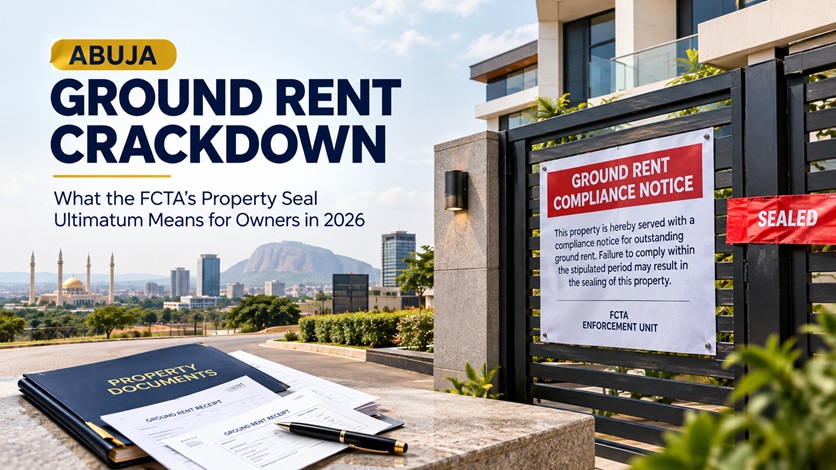
The Abuja ground rent crackdown is no longer a warning. It is an enforcement programme with sealed buildings, revoked titles, and a clear message from the FCTA: pay up or lose the property. In January 2026, the administration said it would begin sealing properties and withdrawing titles the following week. That announcement built on a 2025 drive that revoked thousands of titles over arrears dating back as far as 43 years.
If you own, buy, rent out, or lease property in Abuja, here is what has happened, what is different this year, and what to do now.
What Ground Rent Is and Why It Carries Real Weight
Ground rent is a mandatory annual payment to the government. Under Nigeria’s Land Use Act, the state holds land and individuals hold rights of occupancy. In the FCT, those rights come with conditions. Paying ground rent is one of them. The FCTA’s public notices say it is due in advance from 1 January each year.
That is why non-payment is not an ordinary debt. Continued default can be treated as a breach of the terms of a Right of Occupancy or Certificate of Occupancy. The consequence the FCTA has applied is revocation of the title. The administration also argues that this revenue funds roads, drainage, and other infrastructure across the territory.
How the Crackdown Escalated Since 2025
The sequence matters, because each deadline has been followed by action.
- March 2025: The FCTA said 8,375 property owners in the ten oldest districts of Phase 1 had not paid ground rent through 2024. Together they owed about ₦6.97 billion. Titles in default for ten years or more, 4,794 in total, were revoked. Owners in default for one to ten years got a 21-day grace period.
- 26 May 2025: Enforcement began on the 4,794 properties and sealing started. Affected buildings included government offices, a bank branch, and a political party’s national secretariat. President Bola Tinubu then intervened and approved a 14-day grace period.
- August 2025: Minister Nyesom Wike said the grace period had long expired and that sealing would resume.
- November 2025: A final 14-day grace period ended on 25 November. The FCTA then moved on 1,095 properties in Asokoro, Maitama, Garki, and Wuse. Of these, 835 were ground rent defaulters and 260 owed violation or land use conversion fees.
- January 2026: After the first Executive Council meeting of the year, the Director of Land Administration said sealing and revocation would start the following week. He described the 2026 drive as more comprehensive than 2025.
In November 2025, Wike also said there would be no further extension. So far, the FCTA has held to that line.
What Is Different in 2026: Land Use Conversion

The 2025 drive focused mainly on unpaid ground rent. The 2026 drive is wider. It covers ground rent, Certificate of Occupancy bills, and land use conversion fees.
A major target is plots allocated for residential use that now operate commercially. Officials pointed to properties on Aminu Kano Crescent and Adetokunbo Ademola Crescent in Wuse, and to several streets in Garki Areas 7 and 8. Commercial ground rent is charged differently from residential. Owners who converted use must pay the conversion fee and the adjusted annual rent.
The FCTA also said it would publish a list of high-value defaulters if payments are not regularised. Revoked titles may be re-allocated to compliant citizens or used for public infrastructure. Officials said no one in Phases 1 and 2 would be exempt.
The Penalty Structure Defaulters Faced
When President Tinubu approved the 2025 grace period, the FCTA attached penalties on top of the arrears:
- ₦5 million for properties in the Central Area
- ₦3 million for Maitama, Asokoro, Wuse II, and Guzape
- ₦2 million for Wuse I, Garki I, and Garki II
The same notice gave buyers who had never registered their interest 14 days to obtain Minister’s Consent and register their Deeds of Assignment.
Treat these figures as a record of 2025 terms, not a current price list. Ground rent, conversion fees, and penalties depend on district, plot, and use, and they can change. Confirm what applies to your plot directly with AGIS before you pay.
What This Means If You Own Property in Abuja
Run these checks now, before an enforcement notice arrives:
- Confirm your ground rent is paid up to date. Clear any arrears, pay the current year, and keep every e-receipt.
- Compare current use with the allocated use. If a residential plot now hosts an office, clinic, school, or shop, you may owe a conversion fee and a higher commercial rent.
- Settle any outstanding C of O bill. The 2026 drive covers unpaid certificate bills as well as ground rent.
- Register your interest if you bought from someone else. Obtain Minister’s Consent and register the Deed of Assignment. Our guide to C of O, R of O and Deed of Assignment explains each document, and title perfection covers the final steps.
- Match your records to AGIS. Make sure the plot number, owner name, and payment history on file agree with your documents.
What This Means If You Are Buying
A ground rent default is a title problem, and title problems travel with the property. If the FCTA revokes a title, ownership reverts to the administration. A buyer who has paid the seller in full can be left with nothing.
Before you pay a deposit, especially in Phase 1 and 2 districts, do the following:
- Ask for ground rent receipts for every year, not just the latest one
- Run a title search with AGIS and confirm there is no revocation or pending enforcement notice
- Confirm the current use matches the allocated use
- Check that the seller’s own purchase was registered with Minister’s Consent
- Agree in writing who pays any arrears or conversion fees
Add these checks to your full due diligence checklist. Budget for them too. Our breakdown of hidden fees in Nigerian real estate covers other charges that surface after an offer is accepted.
What This Means for Landlords, Tenants, and Businesses

A sealed building affects everyone inside it. Tenants and businesses can lose access to premises through no fault of their own.
Landlords should confirm their ground rent and use-conversion position before renewing any lease. Tenants and business owners should ask for proof of payment before signing, and avoid long prepaid leases on buildings with unclear title status.
If a lease already exists, check what it says about the landlord’s duty to keep statutory payments current. Take legal advice if the building is at risk.
How to Check and Pay Ground Rent
AGIS runs an online FCT Lands portal. According to its site, owners can pay ground rent, download certified maps, register land titles, and track applications online. Use it to confirm your plot’s record and keep the e-receipt it issues.
If you cannot find your file, or the figures do not match your own records, go to the AGIS office with your title documents. Avoid anyone who offers to clear arrears informally. A payment that does not appear in the official record protects nothing.
Will There Be Another Grace Period?
Past behaviour is the best guide. A presidential intervention in May 2025 produced a 14-day window. The FCTA later held to its stated deadlines and enforced in November. In 2025, its Director of Land Administration also said no court decision restricted the administration’s action on the revoked properties.
Owners who believe a revocation was applied wrongly should take legal advice quickly. Waiting for another extension is a risky plan. For wider context on how the FCTA is using its powers, see our look at FCT land revocation and the new C of O rules and our report on Abuja demolitions in 2026.
Conclusion: Compliance Is Now a Core Part of Owning in Abuja
The Abuja ground rent crackdown has moved from threat to routine enforcement. Titles have been revoked, buildings have been sealed, and the 2026 drive widens the net to land use conversion and unpaid C of O bills.
For owners, the safest position is simple: be paid up, be registered, and use the plot as allocated. For buyers, ground rent history is now part of title verification, not an afterthought.
At MiraEmma Properties, we help owners and buyers check ground rent status, title records, and registration gaps before they become expensive. If you are unsure where a property stands, talk to our team before you pay or sign.
Frequently Asked Questions
What is ground rent in Abuja and when is it due? Ground rent is a mandatory annual payment attached to a Right of Occupancy or Certificate of Occupancy in the FCT. The FCTA’s notices say it is payable in advance from 1 January each year.
How many properties has the FCTA acted against over ground rent? In March 2025, the FCTA said 4,794 titles in default for ten years or more were revoked, out of 8,375 owners in arrears. In November 2025, it moved on a further 1,095 properties, of which 835 were ground rent defaulters.
What penalties did defaulters face? During the 2025 grace period, penalties were ₦5 million in the Central Area, ₦3 million in Maitama, Asokoro, Wuse II, and Guzape, and ₦2 million in Wuse I, Garki I, and Garki II, on top of the arrears. Confirm current amounts with AGIS.
What happens to a property whose title is revoked? Ownership reverts to the FCTA. The administration has said revoked properties may be re-allocated to compliant citizens or used for public infrastructure.
Does the crackdown affect people buying property in Abuja? Yes. A property with unpaid ground rent or a revoked title is a serious risk to a buyer. Ask for ground rent receipts, run an AGIS title search, and confirm Minister’s Consent and Deed of Assignment registration before paying.
Are residential plots used commercially affected? Yes. The 2026 drive targets plots allocated for residential use that now operate commercially. Owners must pay the land use conversion fee and the adjusted annual ground rent.
How can I check or pay my ground rent? Use the AGIS FCT Lands portal, which allows ground rent payment, certified map downloads, title registration, and application tracking online. Keep your e-receipt, and visit the AGIS office if your records do not match.