In August 2026, heavy rainfall submerged homes, vehicles, and businesses across parts of Abuja, including the highbrow Maitama District. Within days, FCT Minister Nyesom Wike ordered the immediate demolition of every structure obstructing the capital’s waterways and green spaces, declaring that no owner, however high-profile, would be spared. Weeks later, Abuja demolition 2026 is still expanding into new districts. If you own property in Abuja, are planning to buy, or are simply trying to understand what’s happening in the city right now, here’s a clear, practical breakdown of the current demolition wave, the legal rules that govern it, and what it means for you.
What Triggered the Current Demolition Wave
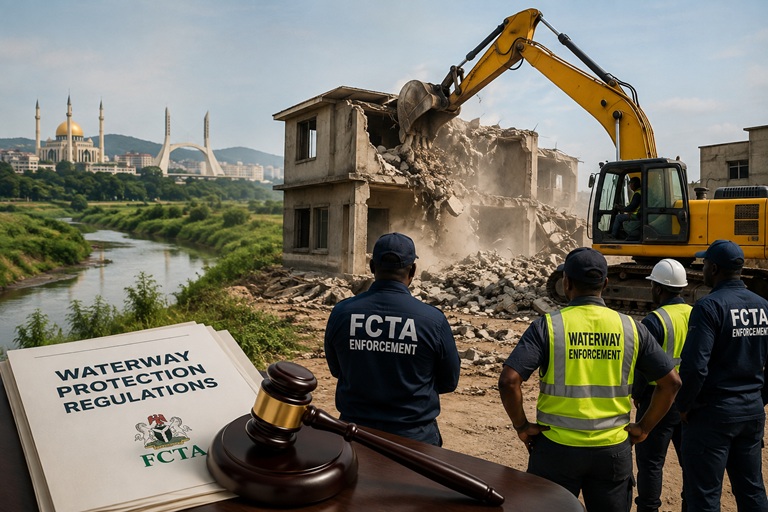
The immediate cause was flooding. Heavy rainfall in mid-August 2026 left Maitama and other districts submerged, with homes, businesses, and vehicles affected. After inspecting the flood-hit areas, Wike directed relevant authorities to begin demolishing structures obstructing waterways immediately, with the exercise initially set to run from Tuesday through Saturday of that week.
The FCTA has framed the flooding as a symptom of a longer-running problem: buildings and green spaces encroaching on drainage channels across the city, worsened by the removal of drainage covers by scavengers and the FCT’s rapid expansion outpacing its drainage infrastructure. A town planning expert and former Coordinator of the Abuja Metropolitan Management Council, Umar Shuaibu, argued the enforcement came too late. He said government should have acted months earlier when warnings about severe weather were first issued.
Where Demolitions Have Happened So Far
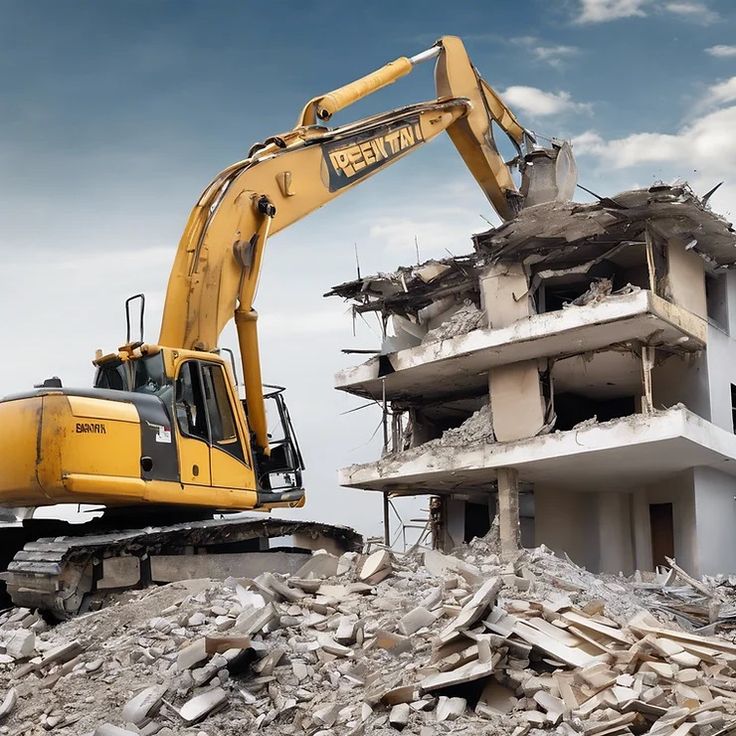
The exercise began in Maitama, where FCDA officials demolished a perimeter fence and part of a gym structure at a residential property on Mississippi Street, along with an unfinished block of apartments near a drainage channel. Officials have since confirmed the demolitions would extend well beyond Maitama. They’ve cited flood damage in Wuse 2, Gudu, and Lokogoma as further justification for enforcement across those districts too.
This is not an isolated incident in Abuja’s recent history. Similar flood-driven demolitions have occurred at Trade More Estate in Lugbe, where the FCTA marked 100 houses for demolition after recurring flooding, and in Durumi, where officials demolished structures as part of a campaign against illegal settlements. The pattern across these cases is consistent: flooding or security concerns trigger enforcement, and the FCTA moves quickly once a directive is issued — which is why verified land title and AGIS-registered allocation matter more than ever for owners trying to establish a legitimate claim.
The Legal Framework Behind FCTA Demolitions
Nigeria’s demolition powers rest on the Land Use Act, which vests land ownership in the state while individuals hold rights of occupancy rather than outright ownership. Agencies like the Federal Capital Development Authority (FCDA) exercise demolition powers under this framework when structures violate the Abuja Master Plan, obstruct designated waterways, or lack proper building approval.
That said, the law does not give the government unlimited discretion. Before a demolition can lawfully proceed, the property owner is generally entitled to a “stop work” order if construction is ongoing, followed by a contravention notice explaining the specific violation. A demolition notice with a timeline typically running 7 to 21 days must follow — the same C of O and revocation protections we covered in our earlier look at FCT land revocation. This requirement is rooted in Section 36 of the Constitution, which guarantees the right to a fair hearing, and is reinforced by state and territorial planning laws.
Compensation rules add another layer. When a property is demolished for overriding public interest, such as road expansion or infrastructure projects, the law requires compensation reflecting the market value of the property and any improvements. This falls under Section 44 of the Constitution and Sections 28–29 of the Land Use Act. Compensation does not typically apply, however, if the structure is illegal, unsafe, or built without proper approval — the basis on which the FCTA has often declined to pay for demolished waterway encroachments.
Not Every Demolition Has Followed the Rules

The gap between the legal standard and what actually happens on the ground has produced real disputes. In one case, house owners in the Kuntuku V. Extension Layout in Gwagwalada took the FCTA to court after more than 20 houses were demolished without notice. This happened despite the owners holding valid title and approved building plans, and they sought compensation the FCTA had not paid.
In a separate, more consequential ruling, a Nigerian court declared a set of Abuja home demolitions illegal and awarded affected residents ₦200 million in compensation. The court found that government agencies had failed to follow constitutional requirements around notice, hearings, and compensation. Legal commentary following the case noted it as a significant precedent: it confirms courts will hold government agencies accountable when demolitions bypass due process, even in enforcement drives framed as being in the public interest.
Court intervention has also stalled demolitions mid-process. In one Wuse 2 case, residents formally notified the Abuja Metropolitan Management Council of a pending High Court suit challenging a demolition action, warning that proceeding before the case was resolved could amount to contempt of court — illustrating that a pending legal challenge can, at least temporarily, halt enforcement.
What This Means If You Own Property in Abuja
If you own a property anywhere near a waterway, green space, or floodplain in Abuja, the current enforcement climate makes a few things worth checking now rather than waiting for a demolition notice:
- Confirm your property sits outside designated waterway and drainage setbacks. Properties built on or encroaching into these areas are the current enforcement priority, regardless of how long they’ve stood.
- Verify your building approval and title documents are complete and current, since the FCTA has been explicit that undocumented or unapproved structures are unlikely to receive compensation if demolished.
- Know your notice rights. If you receive a stop-work or contravention notice, you are generally entitled to a demolition notice with a 7-to-21-day window before enforcement — document any deviation from this process, since it may support a legal challenge.
- Understand that a valid C of O has not always prevented demolition in past enforcement drives, particularly where flood risk or drainage obstruction is the stated justification — legal title reduces your risk but does not eliminate it in these specific cases.
What This Means If You’re Buying Property in Abuja Right Now
For prospective buyers, the current demolition wave is a strong argument for due diligence that goes beyond a standard title search. Before committing to any Abuja property, particularly in flood-prone districts like Maitama, Wuse 2, Gudu, or Lokogoma:
- Check the property’s proximity to mapped drainage channels and waterways, not just its title status, since a clean C of O has not always protected structures built on or near these areas in past enforcement actions
- Ask whether the property or estate has any history of flooding, since areas like Trade More Estate in Lugbe have seen repeated flood damage and repeated demolition threats over several years
- Verify AGIS records and building approvals as part of your standard land title verification process — a property with unresolved approval gaps carries elevated demolition risk independent of the current waterway enforcement drive
- Factor demolition risk into your due diligence checklist as a distinct line item, rather than assuming a valid title alone rules out future government action
The Bigger Pattern: Enforcement Beyond Flooding
Waterway encroachment is the immediate trigger for the current demolition wave, but it sits within a broader FCTA enforcement pattern that Abuja property owners should be aware of. The administration has separately warned owners of undeveloped plots and uncompleted buildings that failure to develop within a set deadline risks title revocation and demolition, citing security concerns over squatters and shanties occupying unmonitored properties. This overlaps with the risks covered in our guide to government acquisition and revocation of land. The FCTA has also run enforcement drives tied to security concerns in areas identified as hideouts for criminal activity, as seen in the Durumi demolitions.
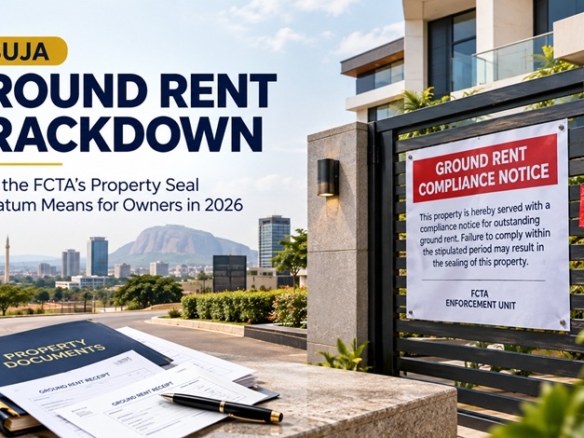
Separately, the FCTA has pursued ground rent enforcement, issuing ultimatums to thousands of property owners over decades of unpaid annual fees, with non-compliance leading to office and property seals. None of this is unique to 2026, but taken together it reflects an FCTA that has become notably more assertive about enforcement across multiple fronts: waterway obstruction, undeveloped land, security concerns, and statutory payment defaults.
Conclusion: Protect Your Property Before Enforcement Reaches You
The current wave of demolitions in Abuja is driven by a real and recurring problem, flooding made worse by construction on waterways and green spaces, but the enforcement process hasn’t always matched the legal standard the Constitution and Land Use Act require. For property owners, the safest position is one where your documentation, building approvals, and physical location relative to mapped drainage channels are all verified and in order, rather than relying on title alone. For buyers, this is now a genuine part of due diligence in Abuja, not an edge case.
At MiraEmma Properties, we help clients check exactly this kind of risk before it becomes a problem, not after a bulldozer has already arrived. If you’re unsure whether a property you own or are considering carries this kind of exposure, talk to our team before you commit further.
Frequently Asked Questions
Why is the FCTA demolishing buildings in Abuja right now? The current wave, which began in August 2026, was triggered by severe flooding that submerged parts of Maitama and other districts. FCT Minister Nyesom Wike ordered the immediate demolition of structures obstructing waterways and drainage channels, and the exercise has since expanded to other flood-affected areas.
Does the government have to give notice before demolishing a property? Generally, yes. Nigerian law requires a stop-work order (if construction is ongoing), a contravention notice, and a demolition notice with a 7-to-21-day timeline, rooted in the constitutional right to a fair hearing. Courts have penalized agencies that skip these steps.
Will I be compensated if my property is demolished? Compensation is legally required when a property is demolished for overriding public interest, reflecting market value under the Land Use Act. However, compensation typically does not apply if the structure is illegal, unsafe, or lacks proper building approval — which the FCTA has cited in several waterway demolition cases.
Can a valid Certificate of Occupancy protect my property from demolition? Not always. In past FCTA enforcement actions, properties with valid title and approved building plans have still been demolished, particularly where flood risk or waterway obstruction was cited, leading some owners to pursue legal action and compensation afterward.
Which Abuja districts are most affected by the current demolition wave? The exercise began in Maitama and has been cited as extending to Wuse 2, Gudu, and Lokogoma, based on flood damage reported in those areas. FCTA officials have said the exercise will continue across the territory.
What should I do if I receive a demolition notice I believe is unlawful? Document the notice and any procedural gaps (missing stop-work order, missing contravention notice, insufficient timeline), and consult a lawyer promptly. Nigerian courts have both halted pending demolitions via injunction and awarded compensation after the fact where due process was not followed.
Should demolition risk affect my decision to buy property in Abuja? It should factor into your due diligence, particularly for properties near waterways, green spaces, or floodplains. Verifying title alone is not sufficient — checking flood history and proximity to designated drainage channels is now a meaningful part of assessing risk.