View Table of Content
The hidden costs of owning property in Nigeria are what separate confident investors from financially stressed ones — and most buyers only discover them after the purchase is complete.
You negotiate hard on the price, transfer the money, collect the keys. And then, within weeks or months, invoices start arriving that nobody mentioned during the sales process. Ground rent. Land Use Charge. Service charge. Withholding tax. AGIS registration fees. Maintenance levies. Generator diesel bills. Each one individually feels manageable. Together, they can add hundreds of thousands — or millions — of naira to your annual cost of ownership.
This guide breaks down every significant hidden cost of owning property in both Lagos and Abuja in 2026, city by city, category by category. Whether you are buying your first home or adding a fifth investment property to your portfolio, these are the numbers you need to know before you sign.
1. The Costs at Purchase — What Lagos and Abuja Charge You to Close a Deal

The purchase price is the number that gets all the attention. But in both Lagos and Abuja, the true cost of acquisition runs significantly higher once all statutory and professional fees are added.
Closing Costs in Lagos
According to The Africanvestor’s 2026 property tax and fees analysis, total buyer closing costs in Lagos typically range from 8% to 15% of the purchase price. On a ₦100 million property, that means between ₦8 million and ₦15 million in additional costs before you receive the keys.
The main components are:
Legal fee: 5% to 10% of the purchase price for your independent conveyancing lawyer. Non-negotiable — you should never rely on the seller’s lawyer to protect your interests.
Stamp duty: Assessed on the transaction value and payable before your documents can be legally stamped. For individuals, the rate in Lagos is 0.5% of the transaction value. For corporate buyers, it rises to 1.5%.
Property registration: Lagos State charges 3% to 5% of the property value for registration and filing at the Lands Bureau.
Governor’s Consent: Required under Nigerian law for most statutory land transfers. Typically 3% to 6% of the assessed property value, and one of the most significant single costs in a Lagos transaction.
Survey verification: Not legally mandatory but strongly recommended. Budget ₦150,000 to ₦500,000 for beacon confirmation to prevent boundary disputes.
The 15% Buffer Rule applies in Lagos more than anywhere else in Nigeria. If your total available budget is ₦100 million, you should target a property priced at no more than ₦87 million — and protect the remaining ₦13 million for these closing costs.
Closing Costs in Abuja
Abuja’s closing costs are structured differently and are generally lower than Lagos on a percentage basis. According to The Africanvestor, closing costs in Abuja typically fall at the lower end of the national range — with registration fees of 1% to 2% plus additional flat administrative fees compared to Lagos’s 3% to 5%.
The main components are:
AGIS registration: All property transactions in the FCT run through the Abuja Geographic Information Systems (AGIS) — the FCT’s centralised land administration platform. AGIS registration fees apply on every transfer and must be paid before the transaction is legally complete.
Governor’s Consent: Applies in Abuja as in Lagos, but FCT administrative processing times are generally more predictable through the AGIS system.
Stamp duty: Applies at similar rates to Lagos for property transfer documents. Note that under the Nigeria Tax Act 2025, stamp duty has been waived on rent agreements below ₦10 million per year — a useful saving for landlords in the mid-market segment.
Legal fee: Same 5% to 10% range as Lagos for an independent conveyancing lawyer.
The Abuja advantage on closing costs is real but modest. On a ₦70 million Abuja property, you might pay ₦7 million to ₦9 million in total closing costs versus ₦8 million to ₦12 million on a comparable Lagos property.
2. Annual Government Charges — The Bills That Keep Coming Every Year
This is where Lagos and Abuja diverge most sharply — and where most buyers are most unprepared.
Lagos Land Use Charge (LUC)
Lagos State imposes an annual Land Use Charge (LUC) on all developed property in the state. This charge consolidates what were previously three separate levies — ground rent, tenement rate, and neighbourhood improvement levy — into a single annual bill.
The LUC rate in Lagos ranges from 0.076% to 0.76% of the assessed market value per annum, depending on property location, size, and use. According to The Africanvestor’s 2026 property tax analysis, this translates to approximately ₦25,000 to ₦500,000 or more per year for most residential properties, with premium Island properties in Ikoyi and Victoria Island paying at the higher end.
What most new Lagos property owners discover too late is that the LUC accumulates penalties when unpaid. Lagos State Internal Revenue Service actively pursues outstanding LUC debts, and in serious cases, properties can be sealed. Before completing any Lagos property purchase, your lawyer must conduct a search to confirm there are no outstanding LUC arrears against the property — because those arrears transfer to you as the new owner.
Abuja Ground Rent (FCTA/AGIS)
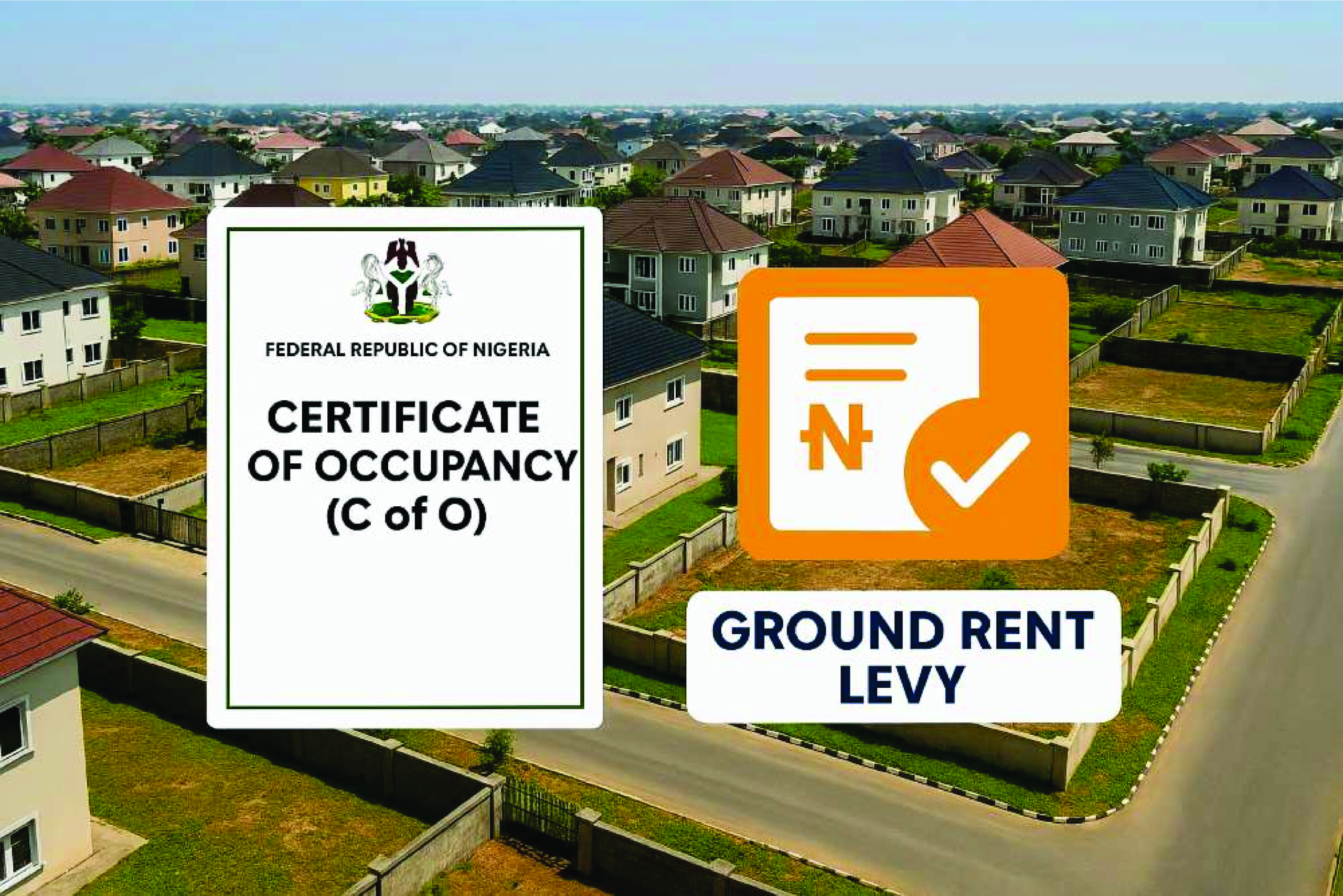
In Abuja, the equivalent annual government charge is ground rent, payable to the Federal Capital Territory Administration (FCTA) through the AGIS/Remita system. Under the terms of every Certificate of Occupancy in the FCT, landowners are legally required to pay annual ground rent to maintain their right to use the land.
Ground rent is due on January 1 each year and must be paid without waiting for a demand notice — though AGIS typically sends bills. The rate is calculated based on land size, district zone, and land use. High-value zones — Maitama, Asokoro, Wuse 2 — attract higher ground rent per square metre. Mid-value zones — Gwarinpa, Wuye, Utako — sit at a lower rate. Developing zones like Lugbe and Kuje pay the lowest rates.
The consequences of non-payment are severe and underappreciated. Over 60% of Abuja landowners reportedly face revocation risk due to missed ground rent payments, according to ICA Nigeria’s 2026 ground rent analysis. In March 2025, the FCTA revoked a tranche of land titles specifically for unpaid ground rent — a real enforcement action, not an idle threat. Property sales, transfers, and leases cannot proceed if ground rent arrears exist against the title. And the FCTA has announced it will begin mass prosecution of persistent non-payers.
This is not a cost you can defer. Build it into your annual ownership budget from day one.
3. Service Charges — The Most Underestimated Cost in Nigerian Real Estate
If ground rent and Land Use Charge are the costs buyers overlook, service charges are the costs they actively underestimate. According to Ownkey’s Nigeria Real Estate Yield and Tax Guide for July 2026, service charges are the highest-variable cost in Nigerian residential investment and the most frequently undisclosed.
Service Charges in Lagos
In Lagos, estate service charges vary enormously by estate quality and management. The breakdown according to Ownkey’s 2026 analysis is as follows:
Basic mid-market estate — generator, security, basic road maintenance: ₦300,000 to ₦600,000 per year for a 2-bedroom unit.
Premium mid-market — full generator, borehole, CCTV, gym access: ₦600,000 to ₦1,500,000 per year for a 2 to 3-bedroom unit.
Prime estate — Lekki Phase 1, Oniru, Osapa London class: ₦1,500,000 to ₦3,000,000 or more per year for a 3-bedroom terrace.
These charges are set by estate management companies, not the government, and they can increase without significant notice. A buyer who purchases a ₦150 million apartment in a premium Lekki estate and budgets only for mortgage repayment or purchase cost has not factored in the ₦2 million to ₦3 million annual service charge that keeps the estate’s amenities running. Over a 10-year ownership period, that is ₦20 million to ₦30 million in service charges alone.
Service Charges in Abuja
Abuja estate service charges follow a similar structure. According to Nigeria Housing Market’s 2026 Abuja rental analysis, service charges in Phase 1 Abuja estates — covering generator schedules, security, and road maintenance — now range from ₦1.5 million to ₦3.5 million per year, depending on the generator schedule and estate facilities.
For mid-market Abuja estates in areas like Gwarinpa, Life Camp, and Wuye, service charges are more modest — typically ₦300,000 to ₦800,000 per year for a standard 2-bedroom unit. But they are rising. The 50% surge in construction and maintenance costs in late 2025 has pushed estate management companies across Abuja to increase their charges to cover rising diesel, security, and maintenance expenses.
4. The 10% Withholding Tax — The Rental Income Cost Nobody Warns You About
If you are buying an investment property rather than a personal home, there is one ongoing cost that catches more Nigerian landlords off guard than any other: withholding tax on rental income.
Nigeria’s Federal Inland Revenue Service (FIRS) levies a 10% withholding tax on all rental income — regardless of whether the landlord is a Nigerian resident, a diaspora investor, or a foreign national. This tax applies equally in Lagos and Abuja, and it is deducted at source before the money reaches the landlord.
According to Ownkey’s Nigeria Property Return Model published in July 2026, the deduction-at-source mechanism means many Lagos and Abuja landlords have never calculated the real cost of this tax — because it never appears in their bank account in the first place. The money simply never arrives.
On a property generating ₦12 million per year in gross rent, the 10% withholding tax alone removes ₦1.2 million before any other deduction. Add management fees of 10% to 15%, service charges, LUC or ground rent, maintenance, and vacancy periods — and Ownkey’s 2026 data shows the net yield is typically 40% to 55% of the quoted gross yield. A property advertised at 9% gross yield delivers approximately 4% to 5% net yield after all real costs are applied.
This is not unique to Nigeria — withholding tax on rental income exists in many countries. But the deduction-at-source model, combined with the fact that most Lagos and Abuja developers and agents quote gross yields rather than net, means the gap between expectation and reality is particularly wide.
5. Energy Costs — Where Abuja and Lagos Diverge Sharply
In 2026, energy costs are one of the most significant and fastest-growing components of property ownership costs in Nigeria — and the two cities experience this cost very differently.
Lagos Energy Costs
In Lagos, grid power reliability varies dramatically by neighbourhood and AEDC/EKEDC feeder band. Properties on Band A feeders receive the most reliable power — 20 hours per day on average — but pay the highest grid tariffs. Properties on Band C or D feeders may receive as little as 4 to 8 hours of grid power daily and must rely heavily on diesel generators or solar systems for the remainder.
For a mid-market Lagos apartment running a 5KVA generator for 8 hours daily, diesel costs alone can reach ₦600,000 to ₦1,200,000 per year at current pump prices. Properties in premium Island estates that run centralised diesel generation pass these costs through in the service charge — which is why premium Lekki and Ikoyi service charges are so high.
Solar installation has become increasingly common in Lagos as a cost-reduction strategy. A quality solar and inverter system for a 3-bedroom apartment costs ₦3 million to ₦8 million upfront but significantly reduces diesel dependency and long-term energy costs.
Abuja Energy Costs
Abuja has a structural advantage over Lagos on power reliability. As the Federal Capital Territory, Abuja receives prioritised AEDC grid allocation, and many Phase 1 residential districts enjoy significantly more stable power supply than equivalent Lagos addresses. However, “more stable” does not mean “reliable enough to eliminate generator dependency.”
In Abuja’s Phase 1 estates, many residential developments use industrial solar banks for daytime loads and switch to diesel generators from 7 PM to 6 AM. The practical result is that Abuja residents with premium estate living still carry meaningful energy costs — just somewhat lower than comparable Lagos properties.
6. The Full Cost Comparison: What Owning Property Really Costs You Per Year
Bringing all of this together, here is a realistic annual ownership cost estimate for a mid-market 3-bedroom apartment in each city in 2026, beyond the purchase price:
In Lagos — Lekki Phase 1 or equivalent:
Land Use Charge: ₦100,000 to ₦300,000
Estate service charge: ₦1,500,000 to ₦3,000,000
Withholding tax on rental income (if letting): 10% of gross rent
Property management fee (if letting): 10% to 15% of gross rent
Energy costs outside estate charge: ₦300,000 to ₦800,000
Maintenance and repairs (annual sinking fund): 5% to 8% of gross rent
Total annual ongoing cost (excluding mortgage): ₦2,000,000 to ₦4,500,000 or more before rental deductions
In Abuja — Gwarinpa, Life Camp, or equivalent:
Ground rent (AGIS/FCTA): ₦50,000 to ₦300,000 depending on zone
Estate service charge: ₦300,000 to ₦800,000
Withholding tax on rental income (if letting): 10% of gross rent
Property management fee (if letting): 10% to 15% of gross rent
Energy costs outside estate charge: ₦200,000 to ₦600,000
Maintenance and repairs: 5% to 8% of gross rent
Total annual ongoing cost (excluding mortgage): ₦600,000 to ₦1,800,000 before rental deductions
Abuja is significantly cheaper to own property in on an ongoing basis. Lagos’s higher service charges — driven by larger, more complex estate infrastructure and higher diesel costs — are the primary driver of that gap.
What This Means for Your Investment Decision
The purchase price gets all the attention. The ongoing costs determine whether your investment actually performs.
A Lagos Island property may offer stronger capital appreciation and premium tenants — but it comes with annual ownership costs that can easily exceed ₦4 million before any mortgage payment. An Abuja mid-market property may offer lower prestige — but its annual ownership costs are a fraction of that figure, leaving more net income in your pocket each year.
Neither city is more expensive to own in across every category. It depends on the specific estate, the property type, the power infrastructure, and whether you are owner-occupying or renting. What is universal is this: if you do not model these costs before you buy, you will meet them after — and they will significantly change the financial case you thought you were making.
At MiraEmma Properties, we walk every client through a full ownership cost model before they commit to any property in Lagos or Abuja. We do not just show you the headline price — we show you what it actually costs to own.
Ready to get the full picture before you buy?
Frequently Asked Questions
What are the hidden costs of owning property in Nigeria?
The main hidden costs of owning property in Nigeria beyond the purchase price include: annual government charges (Land Use Charge in Lagos or ground rent in Abuja), estate service charges (₦300,000 to ₦3 million or more per year depending on estate quality), 10% withholding tax on all rental income deducted at source, property management fees of 10% to 15% of gross rent, energy costs from generators or solar systems, and annual maintenance provisions of 5% to 8% of gross rental value. Together, these can reduce a quoted 9% gross yield to 4% to 5% net.
What is the Land Use Charge in Lagos and how much is it?
The Lagos Land Use Charge (LUC) is an annual property tax levied by Lagos State that consolidates ground rent, tenement rates, and neighbourhood improvement levies. It ranges from 0.076% to 0.76% of the assessed market value per year, translating to approximately ₦25,000 to ₦500,000 or more annually depending on property location and value. Non-payment accumulates penalties and can result in property sealing. Always verify LUC arrears before completing a Lagos property purchase, as outstanding charges transfer to the new owner.
What is ground rent in Abuja and what happens if I don’t pay it?
Ground rent in Abuja is an annual fee payable to the Federal Capital Territory Administration (FCTA) through the AGIS/Remita system, required under the terms of every Certificate of Occupancy in the FCT. It is due on January 1 each year and is calculated based on land size, district zone, and land use — with Maitama and Asokoro paying higher rates than mid-value zones like Gwarinpa and Wuye. Non-payment can result in C of O revocation, and the FCTA actively enforces this. In March 2025, a tranche of Abuja land titles were revoked for non-payment.
Is it more expensive to own property in Lagos or Abuja?
On an ongoing annual basis, Lagos is generally more expensive to own property in than Abuja. The main drivers are higher estate service charges in Lagos — ₦1.5 million to ₦3 million per year in premium Lagos estates versus ₦300,000 to ₦800,000 in comparable Abuja mid-market estates — and higher energy costs from diesel-dependent estate generators. Lagos closing costs are also higher than Abuja on a percentage basis, with Lagos registration fees of 3% to 5% versus Abuja’s 1% to 2%.
How does the 10% withholding tax affect rental property in Nigeria?
Nigeria’s FIRS levies a 10% withholding tax on all rental income, deducted at source before the landlord receives payment. This applies equally in Lagos and Abuja to all landlords regardless of residency status. On a property generating ₦12 million per year in gross rent, the withholding tax alone removes ₦1.2 million before any other deduction. Combined with management fees, service charges, vacancy, and maintenance, Ownkey’s July 2026 Nigeria Property Return Model shows net yields are typically 40% to 55% of quoted gross yields.
What are estate service charges in Nigeria and how do I find out what I will pay?
Estate service charges are fees set by estate management companies — not the government — to cover shared infrastructure costs including generator fuel, security, road maintenance, borehole water, and common area upkeep. They vary enormously: from ₦300,000 per year for a basic mid-market unit to ₦3 million or more per year for a 3-bedroom in a premium Lekki or Abuja Phase 1 estate. Always request the current service charge schedule from the estate management company before purchasing, and ask for the last three years of charge history to assess the rate of increase.