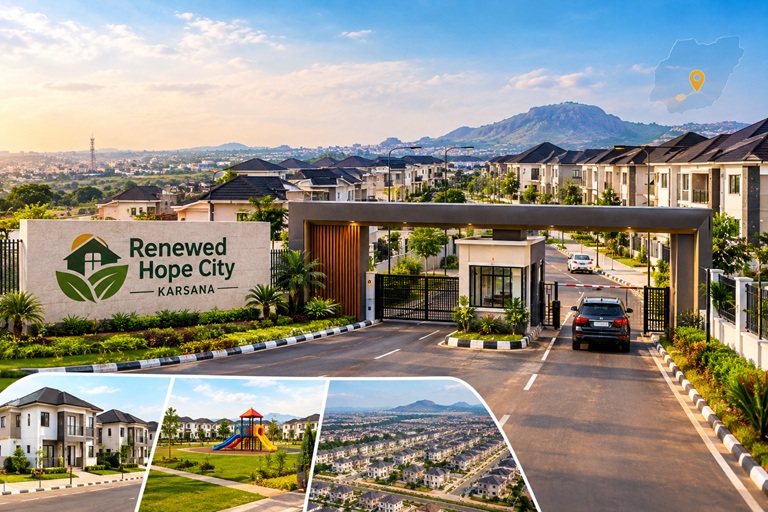
In February 2024, President Bola Tinubu broke ground on a 3,112-unit housing project in Karsana, Abuja, calling it the first practical expression of his administration’s Renewed Hope Agenda for housing. Two years on, the site tells a more grounded story than the launch speech did: multiple housing blocks in active construction, some nearing completion, phased delivery already underway, and real questions about pricing, financing, and timeline that matter more to a prospective buyer than the groundbreaking photos did. Here’s what Renewed Hope City Karsana actually looks like heading toward full commissioning in 2026.
What Renewed Hope City Karsana Actually Is
Renewed Hope City Karsana is the pilot project under a federal Public-Private Partnership between the Federal Ministry of Housing and Urban Development and a consortium of developers, Continental Civil and General Construction and Ceezali Limited, signed in December 2023 to deliver 100,000 houses nationwide. The Karsana site is Abuja’s share of a broader 20,000-unit FCT commitment under the same programme, with the remaining 80,000 units spread across other states.
Under the PPP structure, the Ministry creates the enabling environment and arranges off-takers through the Federal Mortgage Bank of Nigeria (FMBN), while the developer consortium sources land and finances construction. FMBN has separately committed ₦100 billion in off-taker guarantees to support the programme nationwide, on top of its commitment to provide mortgage loans to buyers once units are completed.
The Unit Mix: What’s Actually Being Built
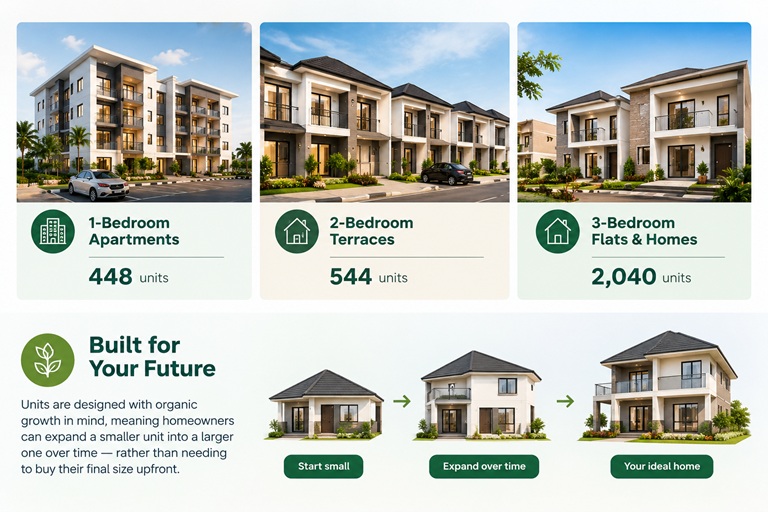
The Karsana site breaks down into three unit types. Reported figures put the mix at roughly 448 one-bedroom apartments, 544 two-bedroom terraces, and around 2,040 three-bedroom flats and homes. Units are designed with organic growth in mind, meaning homeowners can expand a smaller unit into a larger one over time rather than needing to buy their final size upfront.
This mix matters for anyone assessing the project as an investment rather than a home. A development weighted this heavily toward three-bedroom units suggests developers are targeting family buyers and rental demand over single professionals — which should shape expectations for resale and rental liquidity once units are delivered.
What It Costs and How You Can Pay
Pricing at Karsana sits in a distinctly different bracket from the standardized ₦12.5 million three-bedroom bungalow price the Ministry set for Renewed Hope Estates elsewhere in the country. That fixed pricing applies specifically to Estates funded through the Ministry’s own budget — Karsana, as a PPP-funded City, is priced separately by the developer consortium.
Reported price ranges span roughly ₦8 million to ₦22 million for one-bedroom apartments, with broader unit pricing across the site cited between ₦10 million and ₦65 million depending on size and type. Buyers should treat these as indicative rather than fixed, since prices on the ground have reportedly shifted with availability, payment method, and policy updates.
On financing, the project offers several purchase routes: outright full payment, an NHF-backed mortgage through FMBN with tenures reported up to 25 years, an FMBN rent-to-own arrangement, and instalment payment plans arranged directly with the developer. It’s worth checking current NHF terms directly, since NHF rules and ceilings have themselves been revised during 2026.
Where Karsana Sits and Why That Matters
Karsana falls within Phase IV of Abuja’s master plan, inside the Abuja Municipal Area Council, roughly 15 kilometres from Nnamdi Azikiwe International Airport and within a short distance of Gwarinpa, Katampe, and Jahi. That positioning is a meaningful part of the project’s pitch: it sits close enough to established, expensive districts to benefit from spillover demand, while being priced well below what those districts currently command.
The area is still developing around the estate itself, which is typical for large housing projects on Abuja’s expansion edges — buyers should expect surrounding infrastructure and amenities to mature over time rather than arrive fully formed on day one. The federal government has separately approved funding for access road infrastructure specifically to support the Karsana project, an indicator that connectivity work is an acknowledged, ongoing part of the delivery plan rather than an afterthought.
The Honest Read on Where the Project Stands
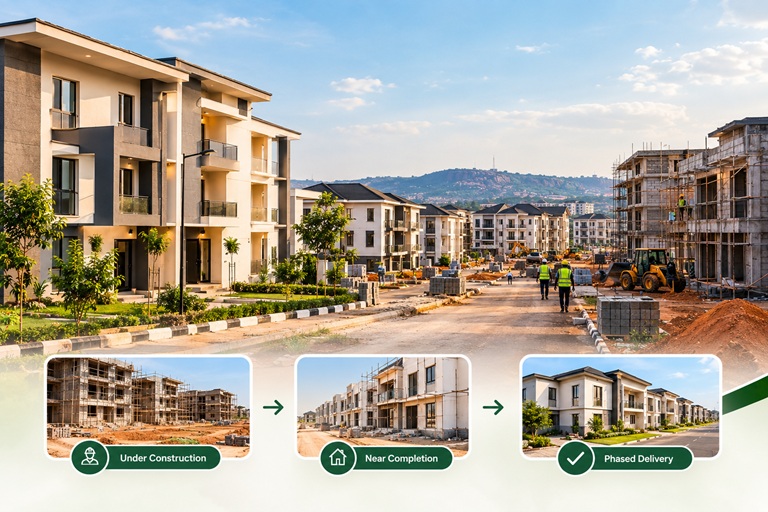
As of site visits reported in March 2026, the project was not fully complete, but multiple blocks were nearing completion with delivery happening in phases rather than as a single handover. That’s a meaningfully different picture from “3,112 units ready for commissioning” — it’s a live construction site with real progress, not a finished city waiting for a ribbon-cutting.
For a buyer, that distinction changes what kind of purchase this is. Buying now likely means buying into a phase still under construction, with delivery timing tied to which block and unit type you’re purchasing, rather than an immediate move-in. That’s not unusual for large PPP housing schemes, but it’s worth going in with realistic expectations rather than treating “commissioning” as a fixed date already guaranteed.
What to Verify Before You Commit
Given the scale and the PPP financing structure, a few checks matter more here than on a typical private estate purchase:
- Confirm current pricing and unit availability directly with the developer consortium or FMBN, since published figures shift and buyers have been advised that prices may change based on availability and policy updates
- Clarify exactly which phase and block your unit falls under, and get a specific, written delivery timeline rather than relying on the project’s overall commissioning target
- Verify the financing route that actually applies to you — NHF mortgage, FMBN rent-to-own, or developer instalment plan — since each carries different terms, tenure, and eligibility requirements
- Do a standard title and documentation check on your specific unit once allocated, the same discipline that applies to any Abuja property purchase, PPP-backed or not
- Budget for the surrounding infrastructure timeline, not just the unit itself, since roads and amenities in expansion districts like Karsana typically mature after the housing does
Conclusion: A Real Project, Still a Work in Progress
Renewed Hope City Karsana is one of the more tangible outcomes of the federal government’s affordable housing push — a genuine construction site with real units going up, not just an announcement. For buyers priced out of Gwarinpa or Jahi but wanting to stay close to that corridor, it’s a legitimate option worth evaluating. But it’s still a project in active delivery, with pricing that moves and a timeline that depends heavily on which block you’re buying into.
At MiraEmma Properties, we help buyers separate a project’s marketing pitch from its actual delivery status before they commit funds. If you’re considering a unit in Karsana or comparing it against other Abuja options, talk to our team first.
.
Frequently Asked Questions
What is Renewed Hope City Karsana? It’s a 3,112-unit housing project in Karsana, Abuja, developed under a federal Public-Private Partnership between the Ministry of Housing and Urban Development and a developer consortium, as the FCT’s pilot site under the nationwide 100,000-unit Renewed Hope Cities and Estates programme.
How much do units at Karsana cost? Reported pricing ranges from roughly ₦8 million to ₦22 million for one-bedroom apartments, with broader unit pricing across the site reported between ₦10 million and ₦65 million depending on size and type. Prices are subject to change based on availability and policy updates.
What financing options are available for Karsana units? Buyers can access an NHF-backed mortgage through FMBN with tenures reported up to 25 years, an FMBN rent-to-own arrangement, developer instalment plans, or outright full payment.
Is the Karsana housing project fully completed? Not as of early 2026. Multiple blocks are nearing completion with delivery happening in phases, but the project overall remains under active construction rather than fully finished.
Where exactly is Karsana located in Abuja? Karsana sits in Phase IV of Abuja’s master plan within the Abuja Municipal Area Council, roughly 15 kilometres from Nnamdi Azikiwe International Airport and close to Gwarinpa, Katampe, and Jahi.
Are Renewed Hope City prices the same as the government’s fixed ₦12.5 million pricing? No. The fixed ₦12.5 million three-bedroom bungalow pricing applies to Renewed Hope Estates funded directly through the Ministry’s budget. Renewed Hope Cities like Karsana are PPP-funded and priced separately by the developer consortium.
Who is the target buyer for this project? The programme is aimed broadly at civil servants, young professionals, and low- to mid-income earners, though the unit mix, weighted heavily toward three-bedroom homes, also makes it relevant for family buyers and investors targeting rental demand.