If you’ve ever waited months for a Certificate of Occupancy in Abuja, or worried whether the plot you’re buying has already been sold to someone else, Nigeria’s land system is finally being rebuilt to fix exactly that problem. Two reforms are driving this shift: Land4Growth, a federal programme designed to unlock trillions of naira in undocumented land value, and a tightened AGIS Abuja land titling policy that now routes all FCT land allocation through a single digital registry. Together, they’re changing how Abuja property buyers verify land, obtain title, and protect themselves from fraud. Here’s what’s actually happening and what it means for your next purchase.
What Is Land4Growth, and Why Was It Launched
Land4Growth, formally the Nigeria Land Titling, Registration and Documentation Programme (NLTRDP), is a federal initiative from the Ministry of Housing and Urban Development, developed in partnership with the World Bank. Housing Minister Ahmed Dangiwa has said the programme is designed to unlock an estimated $300 billion in dead capital trapped in undocumented and poorly titled land across Nigeria.
The scale of the problem is what makes this reform significant. Fewer than 5% of properties in Nigeria are currently formally titled, according to figures cited when the programme launched. That gap deprives state governments of billions in internally generated revenue and locks landowners out of using their property as collateral for loans.
Land4Growth aims to raise formal land registration from under 10% to 50% nationally within a decade. The initial phase covers 18 to 20 reform-ready states, targeting the issuance of over 1 million digital titles and the training of more than 2,000 land administration professionals.
The programme rests on a few core pillars: simplifying titling procedures, digitizing land registries, strengthening the legal frameworks around land rights, and unlocking new land-based financing for both state governments and individual citizens. Renowned lawyer Femi Falana described the programme as a “bold, progressive, and transformative intervention” that should help shield ordinary Nigerians from exploitation by land fraud syndicates.
Why AGIS Is Central to Abuja’s Version of This Reform

While Land4Growth is a national programme, the FCT is already ahead of most states. It has run its own digital land agency, the Abuja Geographic Information Systems (AGIS), for years. Housing Minister Dangiwa specifically cited AGIS as one of the platforms — alongside KADGIS in Kaduna, KANGIS in Kano, EDOGIS in Edo, and NAGIS in Nasarawa — that shows what’s possible when land registries become transparent and technology-driven.
AGIS is the sole official authority for geospatial data, land records, and title documentation across the FCT. Its responsibilities include preparing and issuing Certificates of Occupancy and Rights of Occupancy, producing Title Deed Plans, maintaining cadastral maps and land ownership databases, and running property search and title verification services for buyers.
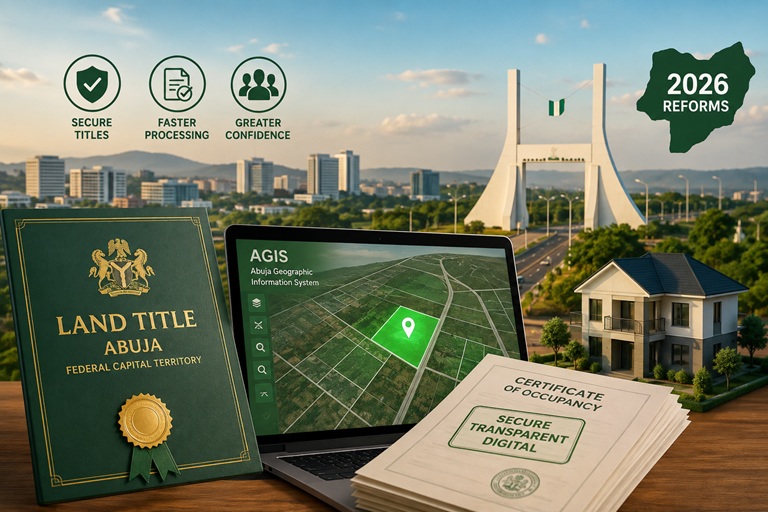
In early 2026, the FCT Administration went further, directing that all land allocation in the territory must now proceed exclusively through AGIS — tightening the rules discussed in our earlier coverage of FCT land revocation and C of O changes. The stated goal is to make every land transaction traceable and verifiable. It’s meant to close loopholes that previously allowed multiple allocations of the same plot and the circulation of forged title documents.
What Changes for Abuja Buyers Under the New Allocation Rules
The FCTA’s AGIS-only directive centralizes land allocation, Certificate of Occupancy issuance, and related documentation under a single digital registry rather than allowing allocations to happen through parallel or informal channels. For buyers, this has a few practical implications:
- Fewer competing claims. Centralizing allocation through one verifiable system is intended to reduce the risk of the same plot being sold to multiple buyers, a problem that has plagued especially the FCT’s satellite towns and Area Council land.
- More traceable transactions. Every allocation, transfer, and C of O issuance is meant to be logged digitally, so a buyer’s title has a verifiable paper trail rather than resting on a physical document alone.
- Slower allocation in some cases, at least initially. Centralizing a previously fragmented process through one agency can create short-term bottlenecks while systems and staffing catch up with demand, something buyers should factor into their purchase timelines.
For Abuja buyers, the practical takeaway is that land bought or allocated outside AGIS’s direct process carries meaningfully higher risk going forward, since it sits outside the system the government itself now treats as the source of legal truth for FCT land.
How to Verify Land Title Through AGIS Before You Buy
Given AGIS’s expanded role, title verification is no longer optional due diligence — it’s the single most important step in any Abuja land or property purchase, and it belongs alongside a full property due diligence checklist rather than as a standalone check. The general process looks like this:
- Gather the seller’s documentation, including the Certificate of Occupancy, survey plan, and any allocation letter or Deed of Assignment
- Submit a title search request to AGIS, which checks the property against its land ownership database and cadastral records to confirm the seller is the legitimate titleholder
- Cross-check the survey plan against the C of O, ensuring the boundaries and coordinates listed match exactly, since mismatches are a common source of later disputes
- Confirm Governor’s Consent status if you’re buying from a secondary owner rather than directly from the original allocation, since a missing consent can complicate a future resale or mortgage application
- Visit the AGIS office in person where needed, since digital records exist but physical verification is still recommended before large sums change hands
It’s worth noting that AGIS itself acknowledges its records are digital, but still recommends physical verification as a safeguard, since sophisticated forged documents remain a real risk in Abuja’s property market. Buyers should treat an AGIS search result as a critical checkpoint, not a final guarantee.
The C of O Recertification Requirement You Shouldn’t Ignore

Alongside the allocation reforms, AGIS has been running a recertification exercise for older Certificates of Occupancy across the FCT. Recertification replaces older, less secure C of O documents with new versions that incorporate identification details such as the holder’s National Identification Number (NIN) and Bank Verification Number (BVN), tying land ownership records directly to a verified individual identity.
This matters for buyers in two ways. First, if you’re purchasing a property with an older, un-recertified C of O, factor the recertification process into your due diligence and, depending on the deal structure, your negotiation. Second, recertification is a fraud-prevention measure. Tying titles to NIN and BVN records is meant to prevent double allocations and ensure only the rightful owner appears in the government’s database — which benefits any buyer relying on that record for a future purchase.
Recertification requires submitting a form (available at the AGIS office or via the official AGIS website), proof of ownership, and the required fees, followed by AGIS verification and, in some cases, a site inspection.
Timelines, Costs, and the Practical Reality for Buyers
Even with digitization, Abuja’s title processes are not instant. Obtaining a fresh Certificate of Occupancy in Abuja can reportedly take anywhere from 6 months to 24 months, depending on documentation completeness and administrative processing speed — a range buyers should plan around rather than be caught off guard by.
Costs for AGIS services — title registration, survey plan processing, geospatial information requests — vary by service and property, and are subject to change with government policy updates. Request current fee schedules directly from AGIS or through a licensed professional rather than relying on older published figures, since fees are periodically revised.
The reality for now is that reform is underway but not yet fully realized. Land4Growth’s own framers have acknowledged that Nigeria is working from a base where under 10% of land nationally is properly titled. Even AGIS, one of the more mature state-level systems in the country, still recommends manual verification alongside its digital records. Treat 2026 as a transition period: the direction of travel is toward more reliable digital title, but the safety net of professional, in-person verification hasn’t disappeared yet.
What This Means If You’re Buying Land Without a C of O

Buying land in Abuja without a Certificate of Occupancy is still possible and still common, particularly for undeveloped land on the FCT’s outskirts, but it is considerably riskier under the tightened allocation regime. Land without a clean, AGIS-verifiable title is more likely to run into problems ranging from difficulty securing a mortgage (many lenders, including MREIF-linked products, require clean legal title) to exposure in the event of a government land use review.
If you’re considering land without a C of O, at minimum: verify the allocation history through AGIS, confirm there is no pending government acquisition or revocation notice on the parcel, and budget both time and money for pursuing formal titling before you build or resell. Buyers who skip this step are the ones most exposed if enforcement of the AGIS-only allocation rule tightens further.
Conclusion: Titling Reform Favors the Careful Buyer
Land4Growth and the FCT’s AGIS-only allocation policy are both moving Abuja’s property market toward a more transparent, harder-to-forge system — but that transition rewards buyers who do their homework and creates real exposure for those who don’t. A property with a verified, recertified C of O and a clean AGIS record is genuinely closer to title perfection, and becoming more valuable relative to an undocumented parcel, not just legally safer.
At MiraEmma Properties, we spend as much time helping clients verify title and navigate AGIS as we do helping them find the right property. If you’re evaluating a plot or property in Abuja and want a second set of eyes on its title status before you commit, reach out to our team — we can help you understand exactly where a property stands before you sign anything.
.
Frequently Asked Questions
What is Land4Growth and how does it affect Abuja specifically? Land4Growth is a federal programme to digitize and formalize land titling across Nigeria. In Abuja, it builds on the FCT’s existing AGIS system, which the federal government has cited as a model for how digital land registries can improve transparency and reduce fraud.
Is AGIS now the only way to get land allocated in Abuja? As of early 2026, the FCT Administration directed that all land allocation must proceed through AGIS, aiming to make transactions traceable and reduce irregular allocations. Land obtained outside this process carries higher legal risk.
How long does it take to get a Certificate of Occupancy in Abuja? The process can take anywhere from 6 months to 24 months, depending on documentation completeness and administrative processing speed.
What is C of O recertification and do I need it? Recertification replaces older Certificates of Occupancy with new versions tied to the holder’s NIN and BVN, intended to prevent fraud and double allocation. If you’re buying a property with an older C of O, factor recertification into your due diligence.
Can I still buy land in Abuja without a Certificate of Occupancy? Yes, but it carries more risk under the current reforms. Verify the allocation history through AGIS, confirm there’s no pending government acquisition notice, and budget for pursuing formal titling.
Does AGIS verification guarantee my land title is genuine? AGIS verification is a critical checkpoint, but AGIS itself recommends physical verification alongside digital records, since forged documents remain a risk in Abuja’s property market.
Will Land4Growth make it easier to use land as loan collateral? That’s one of the programme’s stated goals — formally titled land can be used as collateral for financing, which is part of why the government describes untitled land as “dead capital.”