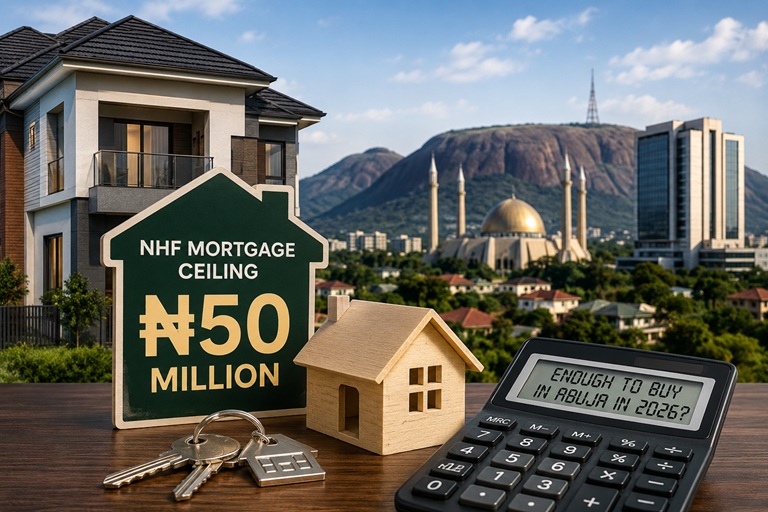
The NHF mortgage ceiling is now ₦50 million, and yes, that’s enough to buy in outer Abuja districts like Lugbe, Kubwa, and Karsana — but not in Gwarampa, Jabi, Wuye, or the city centre. The Federal Mortgage Bank of Nigeria (FMBN) now advertises a maximum National Housing Fund mortgage of ₦50 million, up from the ₦15 million ceiling long associated with the scheme. The loan carries 6% interest and runs for up to 30 years.
But the number that actually decides your outcome isn’t the ceiling. It’s where you’re buying, how much you earn, and how FMBN’s own “up to” clause plays out for your file.
This article breaks down what changed, what ₦50 million realistically buys across Abuja in 2026, who can access the full amount, and how to close the gap when it doesn’t.
What Actually Changed With the NHF Mortgage Ceiling
FMBN’s current NHF Mortgage Loan product page confirms that eligible contributors can access up to ₦50 million. The loan can fund a purchase, a build, a renovation, or a home improvement. It’s disbursed through an accredited Primary Mortgage Bank (PMB), and the process is similar in principle to any Nigerian mortgage qualification route — you need at least six months of continuous NHF contributions before applying.
FMBN itself lends to PMBs at 4%. PMBs then on-lend to contributors at a maximum of 6% per annum, over tenors as long as 30 years.
Older FMBN materials, and several mortgage guides still in circulation, reference a ₦15 million cap. That’s why ₦50 million has drawn so much attention — it’s more than triple what a contributor could previously borrow.
FMBN has also launched a companion product: the Diaspora NHF Mortgage, unveiled on 7 August 2026 in London by Managing Director Shehu Usman Osidi. It shares the ₦50 million ceiling but runs on different terms — a 15-year maximum tenor, a 9% interest rate, and a 70% loan-to-value structure that requires the applicant to fund the remaining 30% upfront.
The phrase that matters most here is “up to.” FMBN is explicit: ₦50 million is a ceiling, not a guaranteed payout. Your actual offer depends on your income, your existing debts, the property’s value, and the PMB’s own lending conditions.
Why ₦50 Million Is Still a Ceiling, Not a Cheque
The biggest misconception about this policy is treating ₦50 million as money every contributor can simply draw down. It isn’t. FMBN’s published conditions cap financing at 90% of a property’s cost or value. That means you need at least 10% in personal savings or another funding source before the mortgage even applies — on top of the hidden closing costs that typically add to a Nigerian property purchase.
Affordability underwrites everything else. A PMB assesses your net income and existing obligations before deciding how much of the ₦50 million ceiling you can actually service.
Here’s an illustration: a fully amortising ₦50 million loan at 6% over 30 years works out to roughly ₦300,000 in monthly repayments. Lenders generally want that figure to sit within a manageable share of your net monthly income. Earn far below that level, and you’ll be approved for less than the maximum, even with a spotless contribution record. That gap between the advertised ceiling and the typical approval is what catches many first-time applicants off guard.
What ₦50 Million Actually Buys in Abuja Right Now

Abuja’s residential market in 2026 is priced in tiers. Location decides whether ₦50 million closes a purchase outright, covers most of it, or barely makes a dent, according to market data compiled by The Africanvestor:
- Studio / self-contained units average about ₦35 million citywide — comfortably within the ceiling.
- 2-bedroom flats average about ₦70 million. The full price sits beyond ₦50 million alone in most districts, though older or smaller units in outer areas can fall within range.
- 3-bedroom flats average about ₦120 million across the city. ₦50 million typically covers less than half unless the unit is in a lower-cost district.
- 4-bedroom terraces average roughly ₦230 million. Semi-detached duplexes average about ₦350 million. Both sit firmly out of single-mortgage reach at the current ceiling.
Geography narrows the gap considerably. Buyers with roughly ₦136 million in total budget — loan plus equity — can find an existing 3-bedroom flat of 100–130 square metres in Kubwa, a 2-bedroom or compact 3-bedroom flat of 80–120 square metres in Lokogoma, or a newer 2-bedroom apartment of 75–100 square metres in Lugbe or Karsana.
A broader entry-level range for a formal urban home in 2026 runs between ₦25 million and ₦60 million. In Abuja, that buys an older 2-bedroom flat of roughly 55–75 square metres in Lugbe.
The takeaway: ₦50 million, combined with reasonable equity, is realistic for entry-level flats in Lugbe, Kubwa, Kurudu, and similar outer districts — several of which also rank among the best neighbourhoods in Abuja for rental income in 2026. It won’t stretch to Gwarinpa, Jabi, Wuye, or the Asokoro–Maitama–Wuse core without a significant top-up.
Who Can Realistically Access the Full ₦50 Million
Not every NHF contributor competes for the same slice of this ceiling. Access depends on three layers of eligibility.

Contribution history. You need six continuous months of NHF contributions before a PMB will process your application. Under the NHF Act, public-sector employees earning the national minimum wage or above must contribute 2.5% of their monthly basic salary. Private-sector employees now contribute voluntarily, following amendments under the Business Facilitation Act. Self-employed Nigerians can register directly.
Income and affordability. The PMB sizes your offer to what your income can service — not to the advertised ceiling. Most first-time applicants underestimate this layer, which is one of several common mistakes that trip up first-time buyers in Nigeria. A modest earner with a clean contribution record may still be approved for only a fraction of ₦50 million.
Property eligibility. The property must be residential. The loan can’t exceed 90% of its cost or value, so a full ₦50 million approval assumes a property priced at roughly ₦55.6 million or above, with the borrower supplying the balance.
The Gap Between the Ceiling and the Abuja Market — And How to Close It
For most salaried Nigerians, ₦50 million alone won’t buy a mid-range home in Abuja’s established districts. Closing that gap usually means combining strategies, not relying on the mortgage in isolation.
- Stack equity savings. Financing caps at 90% of property value. A larger down payment than the required 10% improves approval odds and shrinks the loan size you need.
- Target outer and emerging districts first. Kubwa, Lugbe, Karsana, Kurudu, and Lokogoma consistently offer the closest match between ₦50 million plus modest equity and actual asking prices.
- Consider land-and-build over buy-outright. The NHF facility can finance construction and renovation, not just purchase. Buying land in a developing corridor — after confirming its title status through the current AGIS land titling process — and building in phases can stretch the ceiling further than a finished unit in a saturated district.
- Layer the NHF loan with other financing. Some buyers pair an NHF mortgage with personal savings, cooperative loans, or a structured installment plan to bridge the gap on a higher-value property. That adds a second repayment obligation, which needs separate underwriting.
- Diaspora buyers should note the FMBN Diaspora NHF Mortgage shares the ₦50 million ceiling but structures financing differently: 70% loan-to-value, 9% interest, and a 15-year tenor. That changes both the required equity and the monthly repayment math versus the standard domestic facility.
What This Means for Abuja’s Real Estate Market
A tripled mortgage ceiling changes buyer behaviour before it changes prices. More contributors qualifying for larger loans widens the pool competing for entry-level and mid-tier stock in Lugbe, Kubwa, and Lokogoma — the segments where ₦50 million plus typical equity actually clears asking prices.
Developers building in that price band should see faster absorption. Landlords and investors holding stock priced just above the ceiling may find it worthwhile to structure phased payment plans that bridge buyers across the gap.
For tenants weighing rent versus buy, the comparison is closer than it’s been in years for outer districts — see our full renting vs. buying breakdown for Lagos and Abuja.
Average 3-bedroom rents in Abuja still sit around ₦8.5–₦9 million a year — a number worth measuring against a mortgage’s monthly repayment before assuming buying is automatically cheaper.
Frequently Asked Questions
Is the NHF mortgage ceiling really ₦50 million now? Yes. FMBN’s current NHF Mortgage Loan product page states that eligible contributors can access up to ₦50 million, up from the ₦15 million figure that older materials still reference, subject to income, property value, and other lending conditions.
Does every NHF contributor qualify for the full ₦50 million? No. The ₦50 million is a ceiling, not a guaranteed amount. Your actual approval depends on your income and repayment capacity, your contribution history, and the value of the property, so many contributors will be approved for less than the maximum.
What interest rate applies to the NHF mortgage? The standard NHF Mortgage Loan carries an interest rate of up to 6% per annum for contributors, with FMBN itself extending funds to accredited Primary Mortgage Banks at 4% for on-lending. The separate Diaspora NHF Mortgage carries a 9% interest rate on different terms.
How long do I need to contribute to the NHF before I can apply? At least six months of continuous contributions to the National Housing Fund is required before a Primary Mortgage Bank will process your mortgage application.
Can ₦50 million buy a house in central Abuja districts like Maitama or Wuse? Not on its own. Average prices for 3-bedroom flats across Abuja sit around ₦120 million and semi-detached duplexes around ₦350 million, so ₦50 million typically needs to be paired with substantial additional equity or targeted at lower-cost outer districts such as Lugbe, Kubwa, or Karsana.
Do private-sector employees have to contribute to the NHF? Contribution remains mandatory for public-sector employees earning the national minimum wage or above, while private-sector employees now contribute on a voluntary basis following amendments under the Business Facilitation Act.
What percentage of the property price does the NHF loan cover? FMBN’s lending conditions cap the mortgage at 90% of the cost or value of the property, meaning the borrower must provide at least 10% of the property’s value as equity.
Ready to Put Your NHF Eligibility to Work?
A ₦50 million ceiling is a real opening for Nigerians priced out of Abuja’s mid-tier market — but only if you match the loan to the right district, the right property type, and a realistic view of what your income can service. Weighing Lugbe against Kubwa? Sizing up land-and-build against a finished unit?
Speak with our property advisory team before you commit to a Primary Mortgage Bank application. We’ll map your NHF eligibility against verified listings that fit your budget, and point you toward our guides on Abuja’s best neighbourhoods for rental income and qualifying for a mortgage in Nigeria to get you started today.