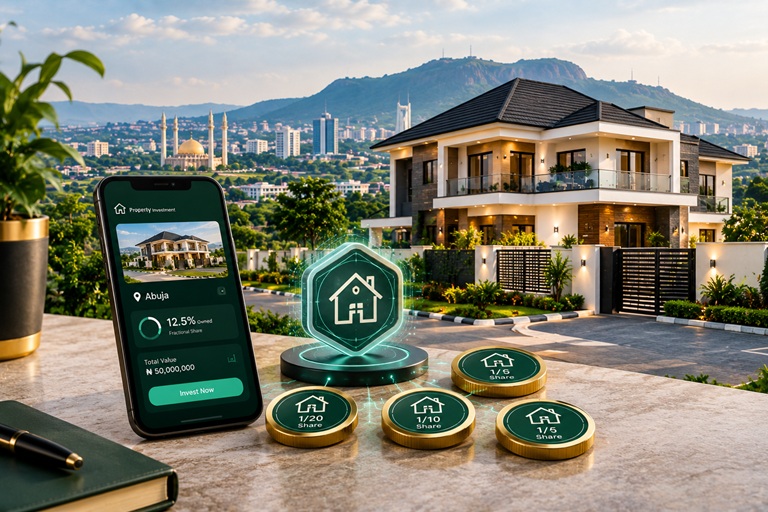
Real estate tokenization Nigeria conversations have picked up fast in 2026, with crypto lawyers and fintech platforms pitching it as the future of property investment — buy a slice of a building for a fraction of its price, trade your stake like a stock, skip the millions-of-naira entry ticket. Nigeria’s Investments and Securities Act 2025 has, for the first time, given this concept real legal footing. But here’s the question that actually matters if you’re looking at a specific property in Abuja: does a token give you any claim on the building itself? The honest answer is no — and understanding why changes how you should evaluate any tokenized real estate offer.
What Real Estate Tokenization Actually Means
Real estate tokenization converts property-linked economic interests into digital tokens on a blockchain, with each token representing a share of value — similar to how a stock certificate represents a share in a company. In practice, the token doesn’t touch the property’s title directly. Instead, a Special Purpose Vehicle (SPV) is created to legally own the real estate, and the token represents an interest in that SPV, a REIT, or a structured investment fund holding the property.
That distinction, token represents a structure that owns the property rather than the property itself, is the single most important thing to understand before evaluating any tokenized offering tied to Nigerian real estate.
The Legal Foundation: What ISA 2025 Actually Changed

Nigeria’s Investments and Securities Act 2025 gave tokenized real estate its first real legal foundation. The Act classifies virtual tokens, including those representing real estate interests, as securities. That brings tokenized property offerings under the regulatory authority of the Securities and Exchange Commission (SEC). Platforms tokenizing real estate must comply with SEC rules, including KYC verification, anti-money-laundering measures, investor disclosure obligations, and VASP (Virtual Asset Service Provider) registration.
Separately, the Nigeria Tax Act 2025, effective January 1, 2026, consolidated rental income, property sales, stamp duties, capital gains, and VAT into a single framework. Property income is now considerably more visible to tax authorities, regardless of whether that property sits in a conventional title or a tokenized SPV structure.
Together, these laws mean tokenized real estate offerings in Nigeria are no longer operating in a complete legal vacuum. But “regulated as a security” and “equivalent to owning land” are two very different things, and that gap is where most of the confusion sits.
Why Tokens Can’t Replace a Certificate of Occupancy
This is the part every Abuja buyer needs to understand clearly: under Nigeria’s Land Use Act, tokenized real estate cannot confer enforceable legal land title. A token can represent an economic interest in an entity that owns a property, but it cannot itself be registered as title the way a Certificate of Occupancy can. Until Nigeria’s land law formally integrates digital tokens, tokenized property ownership remains symbolic rather than a substitute for registered title.
For Abuja specifically, this matters because AGIS, the Federal Capital Territory’s land registry authority, is the sole official source of title documentation for FCT property. AGIS has publicly discussed exploring blockchain, remote sensing, and drone mapping, but as of 2026 it has not deployed a blockchain-based title registry. Lagos State has moved further, announcing a tokenized land registry pilot with a dedicated budget — but that effort is specific to Lagos and doesn’t extend AGIS’s processes in Abuja.
How a Legally Compliant Structure Actually Works
For a tokenized real estate deal to function properly under Nigerian law, the structure generally follows three layers:
- Property holding layer — a Special Purpose Vehicle is created, and the actual property title is transferred into the SPV’s name, making the SPV the legal owner
- Investment vehicle layer — the SPV sits inside a REIT, property fund, or structured investment scheme, which is what investors actually hold an interest in
- Tokenized securities layer — blockchain infrastructure issues digital tokens representing shares in the investment vehicle, functioning as a digital ownership registry for those token transfers
Without a properly structured SPV at the base of that stack, a tokenized property deal has no enforceable legal backing — the token is representing nothing a Nigerian court would recognize as a property interest. Legal commentary in this space has been consistent on this point: the legal foundation starts with corporate and securities structuring, not with blockchain technology.
What This Means If You’re Looking at a Tokenized Abuja Offering

If a platform offers you tokenized shares in an Abuja property, a few questions separate a legitimate offering from a risky one:
- Is there an actual SPV, and does it hold verified title? Ask for the SPV’s registration details and confirm the underlying property has a clean, AGIS-verified title in its name, the same diligence that applies to any Abuja property purchase.
- Is the platform or issuer registered with SEC Nigeria? Under ISA 2025, a compliant tokenized real estate offering should carry SEC registration, KYC requirements, and investor disclosures. An offering skipping these steps is operating outside the framework that makes tokenization legally meaningful at all.
- What exactly does the token entitle you to? A share of rental income, a share of eventual resale proceeds, or voting rights in the SPV, these are all different things, and “fractional ownership” as a marketing phrase can obscure which one you’re actually getting.
- Can foreign investors participate, and does that apply to you? Both Nigerian residents and foreign nationals can generally invest in compliant tokenized Nigerian real estate, though foreign ownership restrictions under Nigerian land law may still apply depending on the underlying property type and location.
Tokenization vs. Other Fractional Investment Routes
It’s worth being clear that tokenization is one route to fractional real estate exposure in Nigeria, not the only one, and not necessarily the most established. REITs, which have operated under Nigerian securities law for years, offer a comparable economic outcome, shared ownership of income-generating property, without needing blockchain infrastructure at all. For a buyer simply looking to invest in real estate without putting up the full purchase price, a REIT and a tokenized SPV structure can deliver a similar result through different mechanics, and the more established route carries a longer regulatory track record.
Tokenization’s real advantage is liquidity and smaller transaction sizes, in theory, tokens can trade more easily than traditional REIT units, and the minimum investment can be lower. Whether that advantage is actually realized depends entirely on whether a functioning secondary market for the tokens exists, which, for most Nigerian offerings in 2026, is still unproven.
Conclusion: Real Legal Footing, Still Not a Land Title Substitute
Real estate tokenization in Nigeria has moved from a speculative idea to something with genuine legal structure under ISA 2025 — that’s a real development, not hype. But for an Abuja buyer or investor, the critical fact doesn’t change: a token represents an interest in a company or fund that owns property, not a claim on the land itself, and AGIS’s title system remains the only authority that can confer enforceable ownership in the FCT. Treat tokenized offerings as a securities investment with real estate as the underlying asset, not as a shortcut to owning a piece of a specific Abuja building.
At MiraEmma Properties, we help investors understand exactly what they’re buying, whether that’s a direct property purchase, a REIT unit, or a tokenized interest. If you’re evaluating a tokenized real estate offer tied to Abuja, talk to our team before you commit capital.
[
Frequently Asked Questions
Can blockchain tokens give me legal ownership of an Abuja property?
No. Under Nigeria’s Land Use Act, tokenized real estate cannot confer enforceable legal land title. A token represents an economic interest in an entity, typically an SPV, that owns the property, not the property itself.
Is real estate tokenization legal in Nigeria?
Yes, within limits. The Investments and Securities Act 2025 classifies real estate tokens as securities and brings them under SEC Nigeria’s regulatory authority, giving tokenization a clear legal foundation for the first time, though no dedicated tokenization-specific law exists yet.
Does AGIS support blockchain-based land titles in Abuja?
Not yet. AGIS has publicly discussed exploring blockchain and other technologies to strengthen its systems, but as of 2026 it has not deployed a blockchain-based title registry. Lagos State has launched a separate tokenized land registry pilot that doesn’t extend to AGIS’s processes.
What structure do legitimate tokenized real estate offerings use?
A properly structured offering uses a three-layer model: a Special Purpose Vehicle that holds the actual property title, an investment vehicle (REIT or fund) that investors hold interests in, and a blockchain token layer representing shares in that investment vehicle.
How is tokenized real estate different from a REIT?
Both offer fractional, income-sharing exposure to property without full ownership. REITs have a longer regulatory track record in Nigeria; tokenization’s theoretical advantage is greater liquidity and smaller investment minimums, though that depends on an active secondary market actually existing.
What should I check before investing in a tokenized Abuja property offer?
Confirm the SPV holds verified, AGIS-registered title; confirm the platform or issuer is SEC-registered under ISA 2025; clarify exactly what the token entitles you to (income, resale proceeds, or voting rights); and apply the same due diligence you would to any property purchase.
Can foreign investors buy tokenized Nigerian real estate?
Generally yes, both Nigerian residents and foreign nationals can invest in compliant tokenized offerings, though foreign ownership restrictions under Nigerian land law may still apply depending on the specific property’s type and location.
