
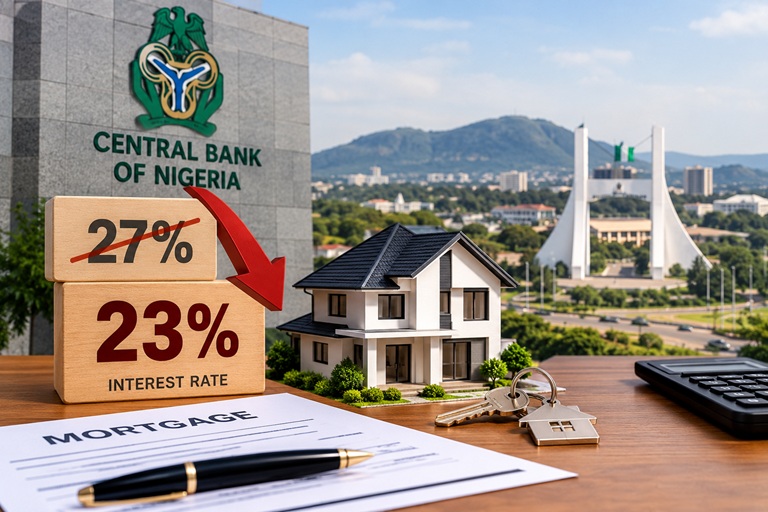
On September 22, 2026, the Central Bank of Nigeria did something no analyst polled by Reuters expected: it cut its benchmark interest rate by 350 basis points, from 26.5% to 23%, the largest single reduction in the bank’s history. The CBN rate cut Abuja mortgages question is the one that actually matters for homebuyers here — does this make financing cheaper? The honest answer is: not automatically, and not yet. Here’s what the cut actually changes and what it doesn’t.
What the CBN Actually Did
The Monetary Policy Committee’s decision at its 307th meeting brought the Monetary Policy Rate (MPR) down to 23% from 26.5%. This followed two consecutive holds at that level in May and July 2026, and an earlier 50-basis-point cut in February. Alongside the rate cut, the MPC recalibrated the Standing Facilities Corridor to +50/-300 basis points around the new MPR, while leaving the Cash Reserve Ratio unchanged at 45% for deposit money banks, 16% for merchant banks, and 75% for non-TSA public sector deposits.
Cardoso framed the move as closing a gap that had opened between the MPR and prevailing market rates, particularly Treasury bill and Open Market Operations yields, which had already traded below 20% before the announcement. In other words, the MPR was catching up to where market rates already were, rather than actively driving rates lower from here.
The timing lines up with easing inflation. Nigeria’s headline inflation eased for a third straight month to 15.39% year-on-year in August 2026, down from 15.43% in July, giving the committee room it didn’t have earlier in the year.
Why the MPR Doesn’t Automatically Change Your Mortgage Rate

This is the part that matters most for Abuja homebuyers, and it’s the part most headlines skip. The MPR is a policy signal, not a retail lending rate. Commercial banks and mortgage institutions set their own lending rates based on their cost of funds, risk appetite, and competitive pressure — the MPR simply influences the environment they’re operating in.
Analysts have been explicit about this. The reduction is particularly relevant to Nigeria’s housing sector because high financing costs have constrained both developers and prospective homeowners. But the impact still depends on whether commercial banks and mortgage institutions actually pass the lower rate through to borrowers. The Lagos Chamber of Commerce and Industry made the same point directly, calling on banks to translate the cut into cheaper credit while warning that lower policy rates do not automatically mean cheaper loans.
Economists were split on how meaningful the cut really is. Muda Yusuf of the Centre for the Promotion of Private Enterprise described it as a timely reset and a major relief for the real sector. Other commentators, including customs agents’ association president Lucky Amiwero, called it insufficient to meaningfully stimulate business and economic activity. That disagreement itself is a signal: don’t treat this as a guaranteed win for affordability until it actually shows up in a bank’s published mortgage rate sheet.
What This Means for Abuja’s Fixed-Rate Mortgage Products
Here’s a detail worth being precise about: Abuja’s two main government-backed mortgage products, MREIF and the NHF, are not directly affected by this MPR cut. MREIF’s mortgage rate is fixed at 9.75% per annum, and the NHF’s rate is fixed at 6% per annum, both set through their own governing structures rather than pegged to the MPR. If you’re financing through either of these, the CBN’s decision doesn’t change your rate.
Where the cut is more likely to matter is on the commercial bank side. Standard mortgage products from Deposit Money Banks have historically carried rates above 25%, tracking market conditions much more closely than MREIF or NHF do. If banks pass the MPR reduction through over time, this is the segment where Abuja buyers could eventually see a real difference, though probably not immediately and not by the full 3.5 percentage points.

What Developers Could See Before Buyers Do
Lower financing costs typically reach developers before they reach individual homebuyers, and that sequencing matters for how this plays out in Abuja specifically. For developers, lower financing costs could improve the economics of projects requiring significant upfront capital that take years to complete. Construction loans, land acquisition financing, and working capital facilities are usually priced closer to prevailing market rates than consumer mortgages are.
If that transmission happens, the practical effect for Abuja buyers may show up less as “cheaper mortgages” in the short term and more as improved supply and pricing on new developments over the next 12 to 24 months, as developers who were previously priced out of financing bring projects forward.
A Global Caution Worth Noting
It’s worth looking outside Nigeria briefly, because the relationship between rate cuts and mortgage affordability isn’t always straightforward, even in markets where transmission is faster than Nigeria’s. In the US, for example, mortgage rates moved higher in September 2026 even as broader rate-cut expectations built, pushing homebuilder confidence to a 12-month low as affordability pressure intensified. That’s a reminder that a central bank rate decision is one input among several — currency stability, inflation expectations, and individual lenders’ own funding costs all matter too.
Nigeria’s own commentators have flagged a related risk. The rate cut increases foreign exchange risk and could complicate the effect of political risk on capital inflows, with some warning that unexpectedly steep cuts can fuel asset price bubbles if cheap credit flows into property and other assets faster than incomes grow. That’s not a reason to expect a bubble in Abuja specifically, but it is a reason to treat “rates are falling” as one data point rather than the whole picture.
What Abuja Buyers Should Actually Do Right Now
Given the gap between the policy signal and what happens at your bank’s mortgage desk, a few practical steps make more sense than waiting for headlines to translate into action:
- Ask your bank or PMB directly whether their mortgage rates have moved, rather than assuming the MPR cut has already been reflected in their offer
- Compare a commercial bank quote against MREIF’s fixed 9.75%, since a commercial rate that hasn’t fully adjusted yet may still be more expensive than MREIF even after this cut
- Watch the next MPC meeting, since a single 350-basis-point move rarely completes its transmission to consumer lending in one cycle — further easing, or a pause, will shape whether this becomes a real trend
- Don’t delay a purchase decision purely on the expectation of falling mortgage rates, given how uncertain and slow transmission has been in past cycles
Conclusion: A Real Shift, But Not Yet a Reason to Recalculate Your Budget
The CBN’s cut to 23% is genuinely significant — it’s the largest single reduction in the bank’s history and a real signal that Nigeria’s tight-money period may be easing. But for Abuja homebuyers, the honest takeaway is that nothing about your mortgage costs has changed automatically. MREIF and NHF rates are fixed regardless of the MPR, and commercial bank rates will only move if individual lenders choose to pass the cut through, on their own timeline.
At MiraEmma Properties, we track how financing conditions actually reach Abuja’s property market, not just what the headlines say. If you’re weighing when to lock in financing for a purchase, talk to our team before assuming today’s rate environment will hold.
Frequently Asked Questions
What did the CBN actually cut its interest rate to in 2026?
The Central Bank of Nigeria cut its Monetary Policy Rate from 26.5% to 23%, a 350-basis-point reduction, at its 307th Monetary Policy Committee meeting on September 21–22, 2026 — the largest single cut in the bank’s history.
Does the CBN rate cut automatically lower my mortgage rate?
No. The MPR is a policy signal, not a retail lending rate. Commercial banks and mortgage institutions decide independently whether and when to pass the reduction through to their own mortgage products.
Does this rate cut affect MREIF or NHF mortgage rates?
No. MREIF’s rate is fixed at 9.75% per annum and the NHF’s rate is fixed at 6% per annum, both set through their own governing structures rather than pegged to the MPR.
Why did the CBN cut rates now?
The committee cited moderating inflation (down to 15.39% in August 2026), improved foreign exchange stability, and external reserves at an 18-year high of $55.25 billion as conditions that created room for the adjustment.
Will Abuja mortgage rates definitely get cheaper because of this?
Not necessarily, and not immediately. Analysts are divided on how much of the cut will reach consumer lending rates, and some have warned the decision could take time to show up in actual mortgage pricing, if it does at all.
Should I wait to buy property in Abuja until mortgage rates fall further?
That’s a personal financial decision, but past rate cycles suggest transmission to mortgage rates can be slow and uncertain. Delaying a purchase purely on the expectation of falling rates carries its own risk.
Are there any downsides to the CBN’s rate cut?
Some economists have flagged increased foreign exchange risk and the possibility that cheaper credit could fuel asset price bubbles if it flows into property and other assets faster than incomes grow.