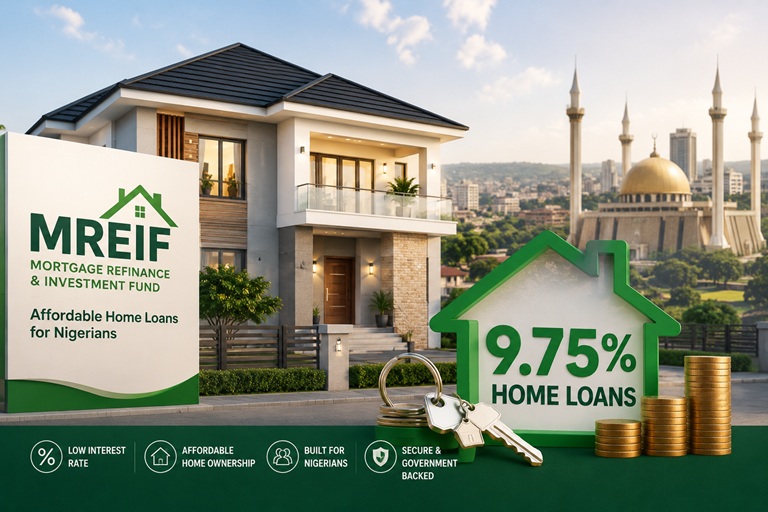
An MREIF mortgage in Abuja gives qualifying buyers a fixed 9.75% interest rate over up to 20 years — roughly a third of what commercial banks typically charge. That single fact is reshaping how Abuja buyers think about financing. Through the MOFI Real Estate Investment Fund (MREIF), Nigerians no longer need to choose between paying cash outright or accepting a punishing variable-rate bank mortgage. This guide covers exactly how an MREIF mortgage works, who qualifies, what it costs, and how an Abuja-based buyer can actually use it.
What Is MREIF and Why It Matters for Abuja Buyers
MREIF is a naira-denominated, government-backed mortgage fund created by the Ministry of Finance Incorporated (MOFI) to channel long-term, low-cost capital into Nigeria’s housing market. It lends to Eligible Financial Institutions (EFIs) and Primary Mortgage Institutions (PMIs) at concessional rates, which those institutions pass on to homebuyers as 9.75% fixed-rate mortgages for terms of up to 20 years.
Abuja buyers going through a conventional commercial bank mortgage typically face variable rates upward of 25%, which pushes many toward outright cash purchases instead. MREIF’s fixed rate removes that unpredictability: a borrower who locks in 9.75% today knows exactly what their repayment looks like in year 15.
The fund is structured as a closed-end unit trust under a ₦1 trillion shelf programme, managed by ARM Investment Managers Limited, with oversight from MOFI and regulatory compliance under SEC unit trust rules.
How Big Is MREIF Right Now — The 2026 Numbers
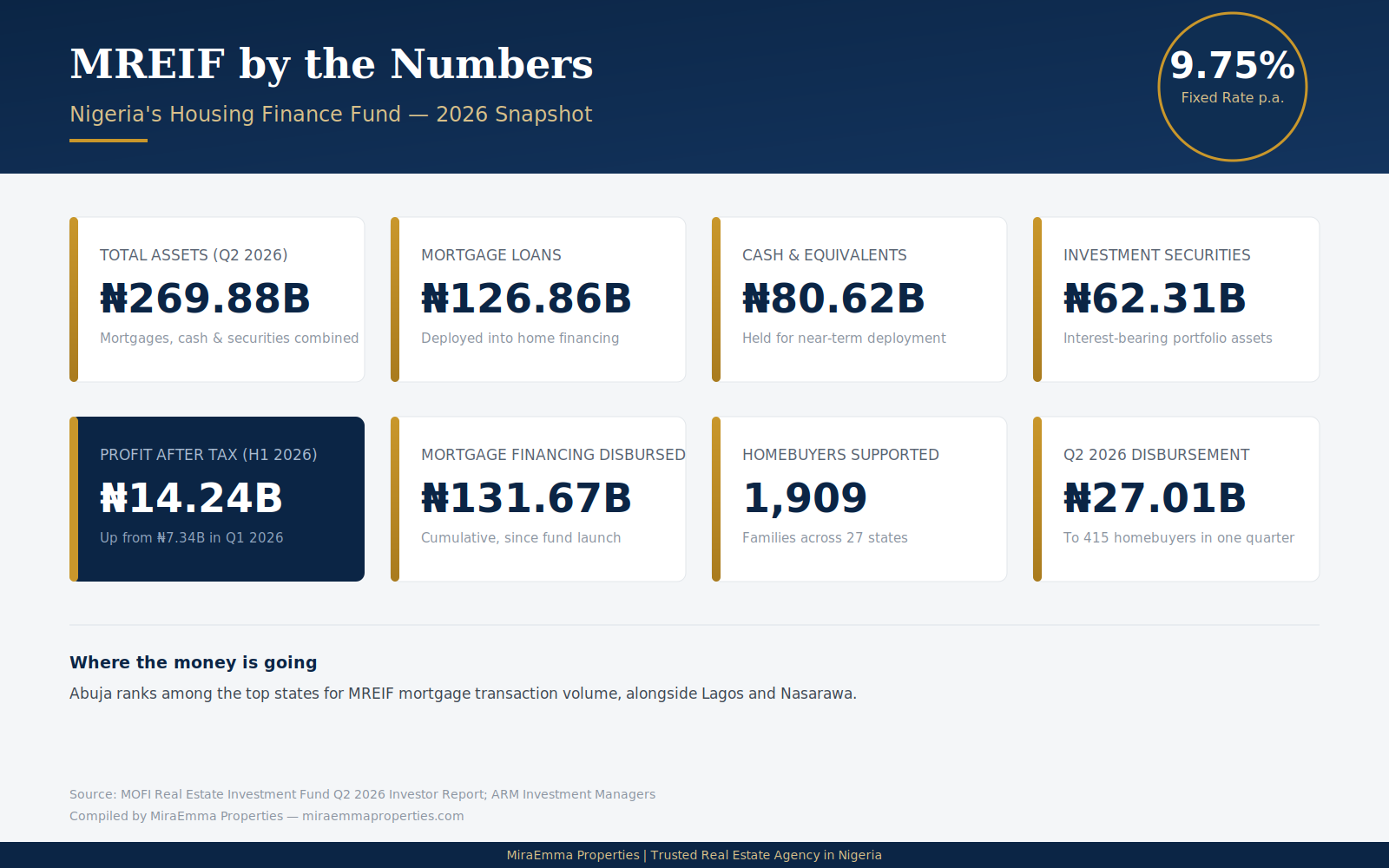
MREIF is not a pilot scheme; it has real, growing balance sheet numbers behind it. As of Q2 2026, MREIF reported total assets of ₦269.88 billion — mortgage loans of ₦126.86 billion, cash and equivalents of ₦80.62 billion, and investment securities of ₦62.31 billion. The fund posted a profit after tax of ₦14.24 billion for H1 2026, building on the ₦7.34 billion it earned in Q1 alone.
On the disbursement side, MREIF’s Q2 2026 investor report shows cumulative mortgage financing of ₦131.67 billion. That has supported homeownership for 1,909 buyers across 27 states, including ₦27.01 billion disbursed to 415 homebuyers in that quarter alone. Abuja, alongside Lagos and Nasarawa, is consistently named among the states with the highest transaction volumes under the fund.
That said, mortgage creation has moved slower than the fund’s ambitions. As of year-end 2025, only about a quarter of the fund’s assets had actually been deployed into mortgages. The fund manager has attributed this gap to property title documentation challenges and registration delays — a reminder that title verification remains a real bottleneck for Abuja transactions, even with cheaper financing available.
Who Qualifies for an MREIF Mortgage
Eligibility is built around citizenship, income stability, and documentation — not a specific profession or salary bracket. To qualify, an applicant generally needs to:
- Be a Nigerian citizen, whether resident in Nigeria or in the diaspora
- Demonstrate stable, verifiable income — salaried employees, self-employed applicants with documented earnings, and even retirees with a steady income stream can apply
- Meet the specified credit and income requirements set by the participating EFI or PMI, which assess whether the borrower can sustain repayments over the mortgage term
- Submit proof of identity, income history, and other supporting documents as required by the lending institution
Age requirements vary slightly by lender. Most EFIs set a minimum applicant age of 21, with the mortgage term structured to end at or before the borrower’s retirement age, commonly 55 to 60 depending on the institution.
One important nuance: MREIF mortgages are only available for completed properties, not off-plan construction, unless the property is developed and marketed by a pre-approved construction company under a separate product. For Abuja buyers eyeing land or an unfinished building on the outskirts of the FCT, the standard MREIF product will not apply until the structure is complete.
The Cost of Borrowing: Rates, Terms, and Equity Contribution
The headline number is the fixed 9.75% per annum interest rate for mortgage terms of up to 20 years, applied through participating EFIs. Beyond the rate, here is what an Abuja buyer should budget for:
- Equity contribution: Most lenders require a minimum upfront contribution of around 10% to 20% of the property’s value, depending on the participating institution’s specific terms
- Loan size: Individual EFIs set their own minimum and maximum loan amounts. Some products start as low as ₦10 million, including for diaspora applicants, and scale up to ₦100 million. Amounts above that are priced separately, subject to income-based affordability limits
- Repayment capacity: Lenders typically apply an installment-to-income limit, meaning monthly mortgage repayments should not exceed roughly a third of the borrower’s verified income — a standard affordability check used globally, not unique to MREIF
- Collateral: A legal mortgage on the property being financed serves as the loan’s collateral
Beyond the mortgage itself, budget for the usual closing costs and legal fees that apply to any Nigerian property purchase, since MREIF financing does not cover these.
One route worth knowing about for salaried Abuja professionals is the MREIF Specialized Mortgage Solution. It allows employed Nigerians with an active Retirement Savings Account to draw on up to 25% of their RSA balance for the equity contribution, provided they have contributed for at least 60 months and are not within three years of retirement.
How the Application Process Works
MREIF mortgages are not applied for directly through MOFI; they are disbursed through the fund’s network of participating EFIs and PMIs. In practice, the process looks like this:
- Check eligibility against the citizenship, income, and credit criteria outlined above
- Approach a participating bank or Primary Mortgage Institution, or register interest through the MREIF homebuyer platform, to begin the application
- Select or confirm a property — either from MREIF’s marketplace of pre-approved, completed housing units or a private property that meets the fund’s underwriting standards
- Submit documentation, including proof of identity, income verification, and any employer or business records requested by the lender
- Undergo underwriting, which includes credit checks, a property appraisal, and legal title verification against the Nigerian Mortgage Refinance Company’s Uniform Underwriting Standards
- Pay the equity contribution and receive mortgage disbursement once approval and legal documentation are finalized
For Abuja buyers specifically, the title verification step deserves extra attention. MREIF underwriting requires clean legal title. Properties without a proper Certificate of Occupancy, or with unresolved Right of Occupancy issues common in some FCT satellite towns, are likely to stall here regardless of how strong the applicant’s income profile is.
MREIF vs. the National Housing Fund (NHF): What’s the Real Difference
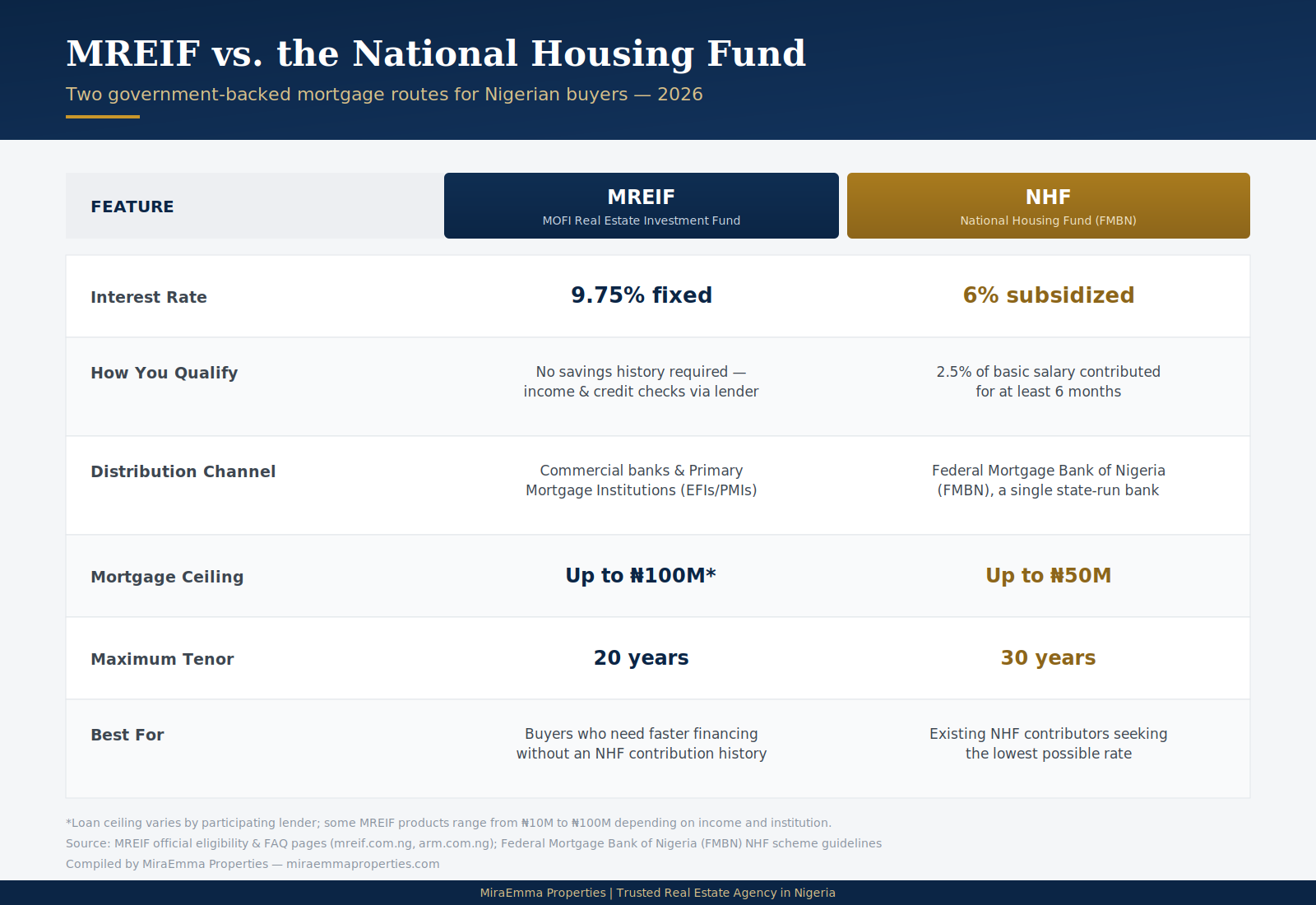
Abuja buyers often confuse MREIF with the older National Housing Fund scheme run by the Federal Mortgage Bank of Nigeria (FMBN), but the two are structurally different products aimed at different needs.
The NHF is a compulsory savings-linked scheme: employees contribute 2.5% of their basic monthly salary, and after six months of regular contributions, they become eligible to borrow against the fund at a subsidized 6% interest rate, with a mortgage ceiling recently raised to ₦50 million. It is slower-moving and contribution-dependent, but the interest rate is lower than MREIF’s installment plan alternative.
MREIF, by contrast, does not require a savings history. It is a market-facing, private-sector-led mortgage product backed by government capital, distributed through commercial banks and PMIs rather than a single state-run bank. Its 9.75% rate sits between NHF’s subsidized 6% and the 25%-plus rates typical of standard commercial mortgages.
For an Abuja buyer who is not an NHF contributor, or who needs financing faster than the NHF process allows, MREIF is currently the more accessible middle-ground option — even though NHF offers a cheaper rate for those who already qualify.
What Slows Down MREIF Mortgages in Abuja (And How to Avoid It)
Despite strong fund performance, the gap between MREIF’s total assets and its actual mortgage disbursement points to friction that Abuja buyers should plan around rather than be surprised by.
The most cited bottleneck is property title documentation. A significant share of FCT properties, particularly those on Area Council land rather than land administered directly by the Abuja Geographic Information Systems (AGIS), lack the clean Certificate of Occupancy that MREIF underwriting requires. Buyers should prioritize verified C of O status from the outset, rather than assuming title issues can be resolved after an offer is accepted.
The second friction point is that only completed properties qualify under the standard mortgage product. Abuja’s off-plan and under-construction estate market is large, but buyers hoping to use MREIF financing for a unit that is not yet built will need to wait until practical completion, or specifically seek out MREIF-accredited developer projects that qualify under the fund’s off-take guarantee structure.
Conclusion: Is MREIF Worth Pursuing for Your Abuja Purchase?
For Abuja buyers with stable, verifiable income and a property with clean legal title, MREIF represents the most competitively priced mortgage financing currently available outside the NHF scheme — a fixed 9.75% rate over 20 years is a meaningful improvement on the commercial bank alternative. The trade-off is that it works best for completed, properly titled properties, and applicants should expect the underwriting process, particularly title verification, to take real time.
At MiraEmma Properties, we spend as much time helping clients understand financing options like MREIF as we do helping them find the right property. If you’re evaluating whether a specific Abuja listing would qualify for MREIF-backed financing, our team can help you check title status and connect with the right participating institutions before you commit. Reach out to us to start that conversation.
Ready to find out if your next Abuja property qualifies for a 9.75% MREIF mortgage?
.
Frequently Asked Questions
What is the current MREIF mortgage interest rate? MREIF mortgages carry a fixed interest rate of 9.75% per annum for terms of up to 20 years, disbursed through participating Eligible Financial Institutions and Primary Mortgage Institutions.
Can Nigerians in the diaspora apply for an MREIF mortgage in Abuja? Yes. Nigerian citizens living abroad are eligible to apply, and some MREIF-linked products set a minimum loan amount of ₦10 million for diaspora applicants specifically.
Does MREIF cover off-plan or under-construction properties in Abuja? Generally no. Standard MREIF mortgages are limited to completed properties, though off-plan financing may be considered for units developed by pre-approved construction companies under a separate product.
How much deposit do I need for an MREIF mortgage? Most participating institutions require an equity contribution of roughly 10% to 20% of the property’s value, though the exact figure depends on the specific lender and product.
Is MREIF the same as the National Housing Fund (NHF)? No. NHF is a savings-linked scheme run by FMBN with a subsidized 6% rate, requiring at least six months of salary contributions. MREIF is a market-facing mortgage product at 9.75%, distributed through commercial banks and PMIs without a savings history requirement.
Why do some MREIF mortgage applications in Abuja get delayed? The most common cause is title documentation. Properties without a clean, verifiable Certificate of Occupancy or with unresolved land title issues typically fail underwriting checks before financing can be approved.
Can I use my pension savings to fund my MREIF equity contribution? Employed Nigerians with an active Retirement Savings Account may draw on up to 25% of their RSA balance toward the equity contribution under MREIF’s Specialized Mortgage Solution, subject to a minimum of 60 months of pension contributions.